How to Start a Lean Ecommerce Business in 2026
A lean, automation-first blueprint for solo founders and emerging-market entrepreneurs. Real cost tables, verified numbers, legal basics, platform comparisons, and a 90-day plan.

Cephas Tope
Builder and certified life coach behind Cephastope. I ship the site and coach the strategy — the All-Way-In Approach.
Live work: ABOVE · Handmework · Elenvara · Full bio
Every year, someone publishes an article explaining why it's too late to start an ecommerce business.
Every year, the market proves them wrong.
Global ecommerce hit $6.7 trillion in 2025. It's projected to reach nearly $8 trillion by 2027. In the US, ecommerce accounted for 16.9% of total retail sales in Q1 2026.
It grew 9.8% year over year — more than double the 3.9% growth for total retail in the same period. Physical retail is growing. Ecommerce is pulling away.
Here's what most guides won't tell you: the opportunity hasn't shrunk.
The cost of entry has changed. Customer acquisition costs are up. Attention is shorter. Platforms are more crowded.
That doesn't mean ecommerce is dying. It means founders who understand unit economics and run lean, semi-automated operations are the ones winning now.
This guide is for a specific kind of founder.
You might be starting from scratch with a small budget and no technical background. You might be a side-hustler in Nigeria, Ghana, or the UK who wants a real asset — not a dropshipping experiment. You might be someone who tried once, watched the ad spend disappear, and wants to do it properly this time.
Here's what you'll find: how to choose the right model for your resources, how to map real startup costs before you spend a naira or a dollar, how to handle the legal basics without hiring a lawyer on day one, and how to use automation and AI so you're not doing everything manually.
You don't need a warehouse. You don't need a team. You need a clear model, honest numbers, and a plan for your first 90 days.
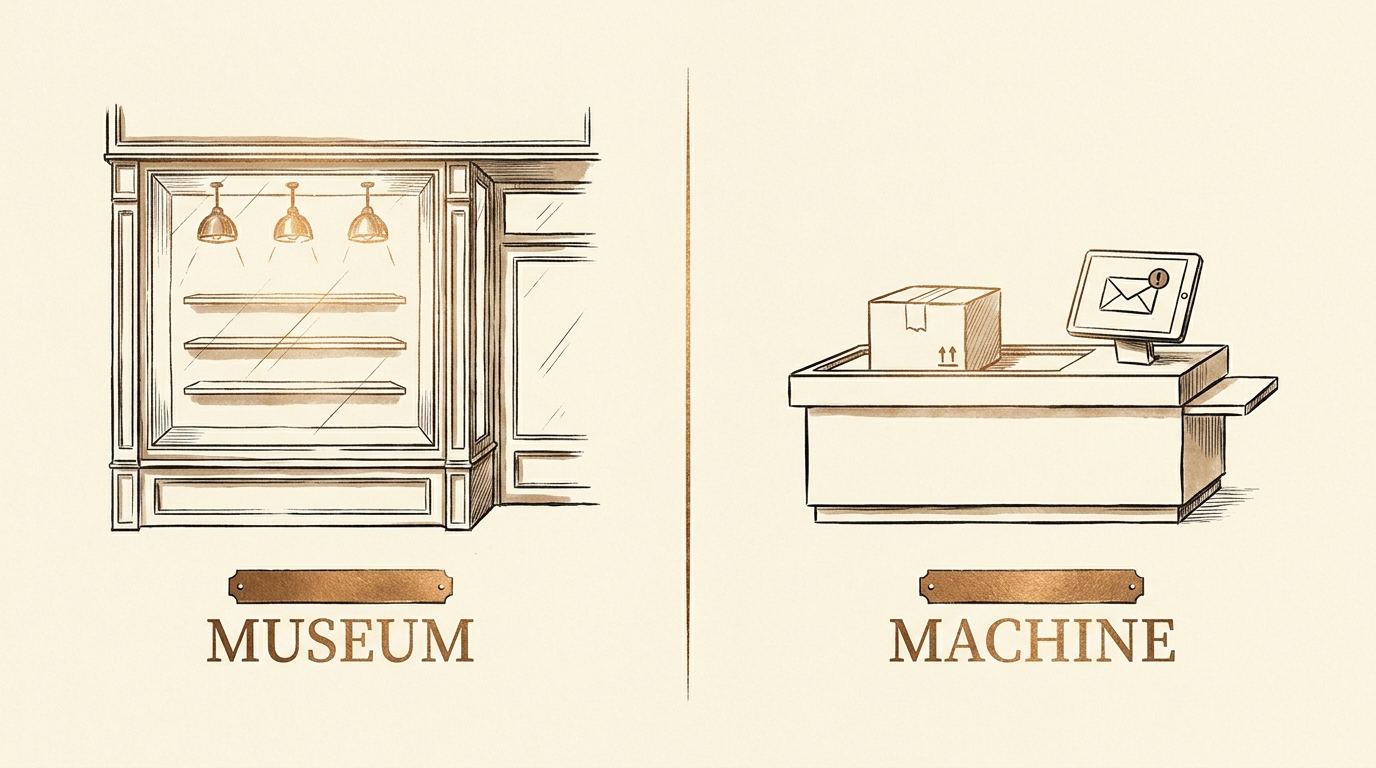
Understand Ecommerce Models and Choose Your Lane
There's no single right way to sell online. But there is a right model for your current budget, timeline, and risk tolerance.
Most people hear "ecommerce" and imagine a Shopify store with their own products. That's one model. The differences between models — in startup cost, margin, and time to first sale — are significant enough to determine whether you survive the first six months.
The core business types: B2C (you sell direct to consumers), D2C (you own the brand, cut out intermediaries), B2B (you sell to businesses in volume), and C2C (peer-to-peer, like Etsy or Depop). Most first-time founders start B2C or D2C. Lowest barrier, shortest sales cycle.
Within those types, your delivery model is what determines your economics.
Quick Comparison: Model vs Capital vs Margin vs Time to First Sale
| Model | Startup Cost | Gross Margin | Time to First Sale |
|---|---|---|---|
| Dropshipping | $500–$2,000 | 10–30% | 1–2 weeks |
| Wholesale | $2,000–$10,000 | 20–50% | 2–4 weeks |
| Private Label | $5,000–$20,000 | 40–70% | 3–6 months |
| Digital Products | $200–$1,000 | 70–95% | Days to weeks |
| Handmade/Etsy | $100–$500 | 40–80% | Days via marketplace |
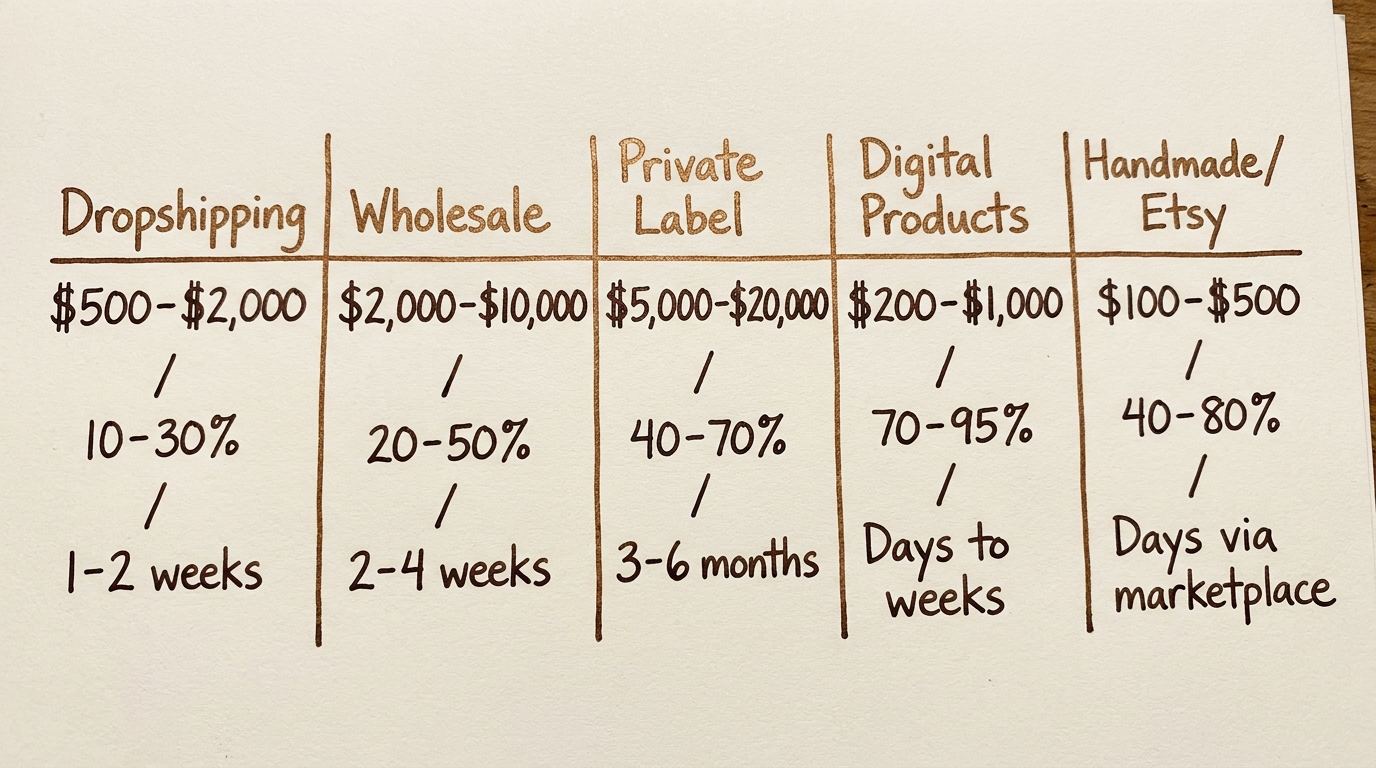
Source: EcomProfits startup cost and margin ranges by model.
Dropshipping means you list products you don't hold in stock. When a customer orders, your supplier ships directly to them. Low capital, low risk, low margin. Solid for testing product-market fit — not for building a real brand.
Private label means you source from a manufacturer, brand the product as your own, and sell under your name. Margins of 40–70%, but 3–6 months before your first sale and a $5,000–$20,000 startup range. The path to a real brand. Not the path for a beginner with a tight budget.
Digital products are the sleeper. No inventory, no shipping, no customs.
Startup cost: $200–$1,000. Margins: 70–95%. Time to first sale: days.
Courses, templates, guides, tools — if you have knowledge worth packaging, this deserves serious consideration.
Wholesale is buying in bulk at trade prices and reselling. Better margins than dropshipping, lower than private label. You need working capital for inventory.
How to choose. Under $2,000 and need to see a sale before committing further: start with digital products or dropshipping, pick one niche, test for 60 days.
Have $5,000–$20,000 and patience for a 6-month build: private label is the path to defensible margin and a real brand. If you're an expert at something: digital products first, physical later.
Don't run two models at once in year one. You don't have enough attention.
Get Clear on Niche, Product, and Market Demand
Most people spend too long picking a niche. Most people also pick the wrong one. Those two facts are connected.
The mistake is treating a niche like a creative decision — something that requires inspiration. It doesn't. It's a research decision. You're not asking "what do I love?" You're asking: where is demand already real, and is it specific enough that I can stand out?
Competition validates demand. If nobody else is selling what you want to sell, that's not a gap — that's a warning. Real opportunities have competitors. You want a niche with competition and a clear reason customers would choose your version.
How to Find Product Ideas
Start where complaints live.
Amazon reviews, Reddit threads, Facebook groups, TikTok comment sections — everywhere people say "I wish this product did X instead of Y" is a brief for a better product.
The complaint is specific. The audience is real. The purchase motivation is strong.
Other places worth checking:
- Google Trends: Look for consistent interest over 12 months, not a spike. Spikes are moments. Consistent interest is a market.
- Marketplace bestsellers: Etsy, Amazon, and Shopify's trending sections show you what's already moving. You're not copying — you're confirming demand.
- Social UGC: TikTok's search function surfaces what people are genuinely buying and filming. Unboxing and review videos in a category are proof of enthusiasm and repeat-purchase potential.
- Customer complaints: The gap between what's available and what customers actually want is where new products live.
How to Validate Before You Spend
You don't need a finished product to test demand. You need a clear promise and a way to measure interest.
The simplest validation: build a landing page describing the product, drive 50–100 people to it (friends, a small ad, a social post), and measure clicks to a "buy now" or "get notified" button. If nobody clicks, the promise isn't compelling. Revise it or move on.
If you're going physical, try a pre-order. Announce the product, take payments, fulfill later. This is how Allbirds and MVMT watches validated before spending on inventory.
If you're going digital, offer the product to five real people at a discount before you build it. If they won't pay a reduced price, they won't pay full price. If they do pay, you have proof and initial cash flow.
The goal is not to eliminate risk. It's to move from "I think this will work" to "I have evidence this will work" before committing significant money.
Map the Real Costs and Unit Economics Before You Spend
Here is where most new ecommerce founders make a critical, expensive mistake.
They plan for the cost of building the store. They forget the cost of running it.
Let me be specific. Cost ranges by scenario, from verified sources:
Startup Budget by Scenario
| Scenario | Total Launch Budget | What's Included |
|---|---|---|
| Lean (dropshipping, digital) | $500–$2,000 | Platform fee, domain, basic theme, initial ads |
| Standard (small DTC brand) | $3,000–$15,000 | Inventory, Shopify theme, logo, 2 months ad spend |
| Aggressive (private label, branded) | $15,000–$25,000+ | Full branding, inventory MOQ, warehouse deposit, ads |
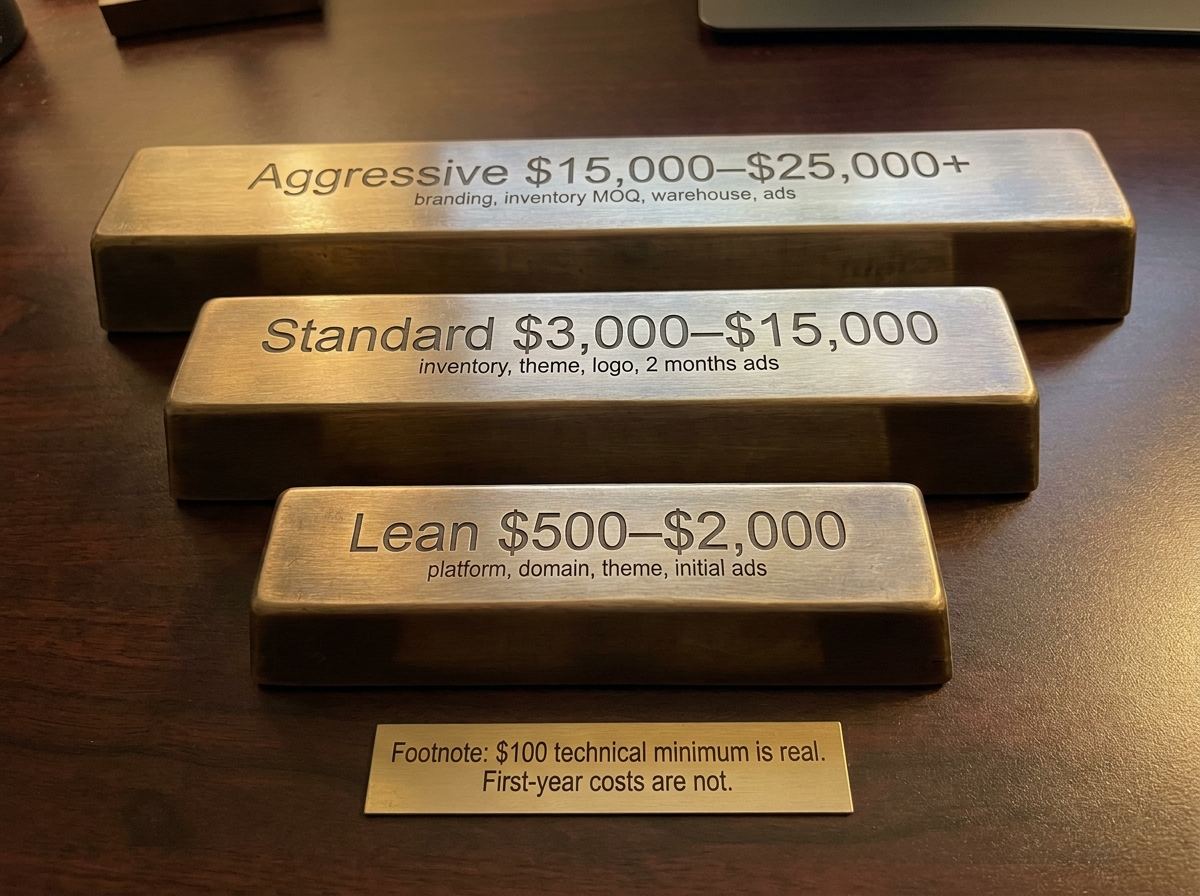
Source: Home Business Magazine, Let'sTalkShop, Shopify.
Shopify's own data is instructive: yes, you can technically launch a store for around $100 — domain plus a basic theme. But survey data from actual new store owners shows first-year costs typically reach thousands of dollars once you account for product, shipping, team, online store, offline, and marketing. The $100 figure is technically true and practically misleading.
The Unit Economics You Must Understand
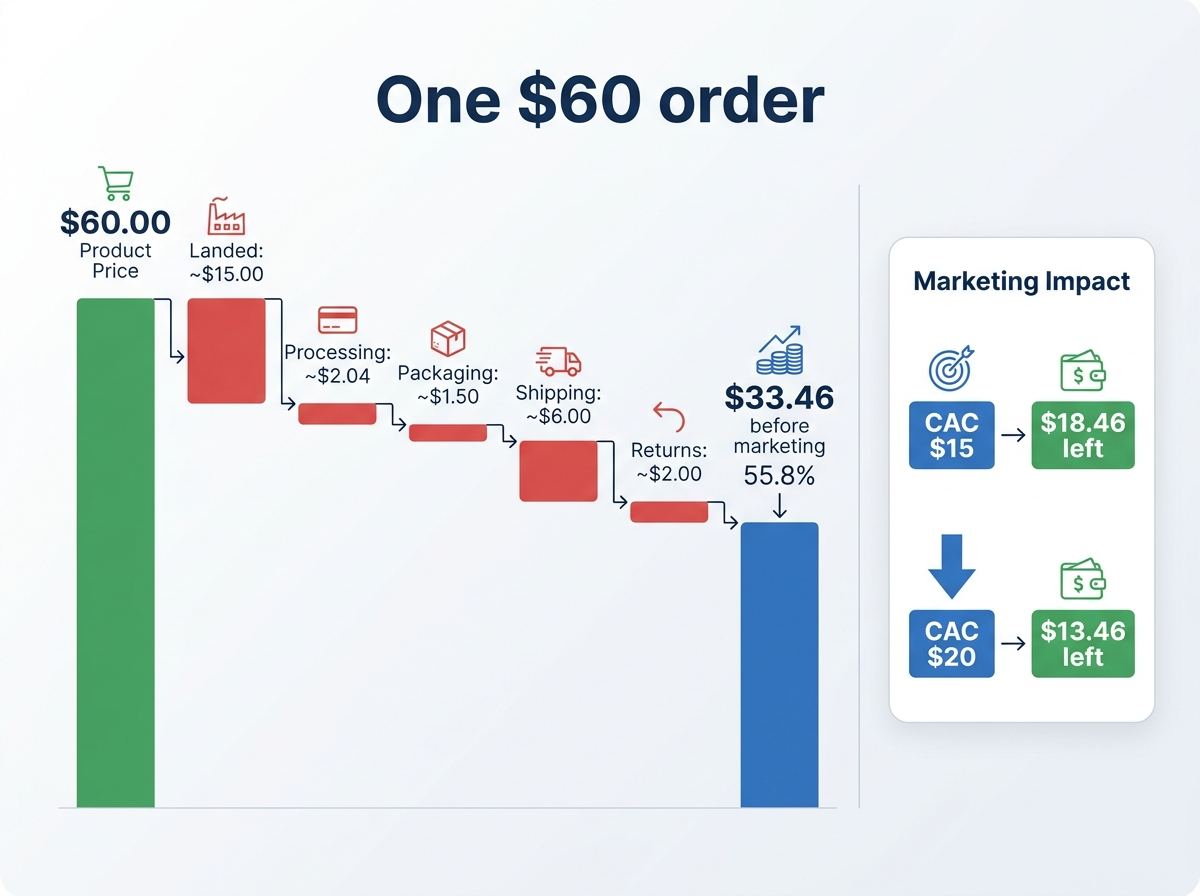
A worked example, adapted from Funnelish's analysis of a $60 physical product:
You sell a product at $60.
- Landed cost (manufacturing + import): ~$15
- Payment processing (Stripe rate: 2.9% + $0.30): ~$2.04
- Packaging: ~$1.50
- Outbound shipping: ~$6.00
- Estimated returns reserve: ~$2.00
- Contribution before marketing: ~$33.46 (roughly 55.8% margin)
That looks healthy. Until you run paid ads.
A $15 customer acquisition cost (CAC) leaves you $18.46 per order. A $20 CAC leaves $13.46. A 20% discount coupon to win the customer? That $12 discount erases most of your remaining margin before marketing even starts.
This is why "just run ads" fails for thin-margin businesses. The math doesn't survive contact with real ad costs.
Two things protect you here.
First: choose products with margins above 40% so you have room for a realistic CAC.
Second: build for repeat purchase. The second and third sale from the same customer cost zero to acquire. Lifetime value (LTV) is the number that actually determines whether a business is profitable — not the margin on a single order.
One More Number to Track From Day One
Your contribution margin per order — revenue minus variable costs per sale, before fixed overhead — tells you whether the business is economically viable at current volume. If this number is negative, no amount of volume will fix it. You need to reduce costs, raise prices, or reduce CAC.
Track it from your first sale. Not month three. The first one.
Legal, Tax, and Compliance Basics
Nobody wants to do this part. Do it anyway.
Getting the legal structure right early protects your personal assets, unlocks business banking, and signals to suppliers, payment processors, and wholesale partners that you're a real operation. Do it before the first order, not after.
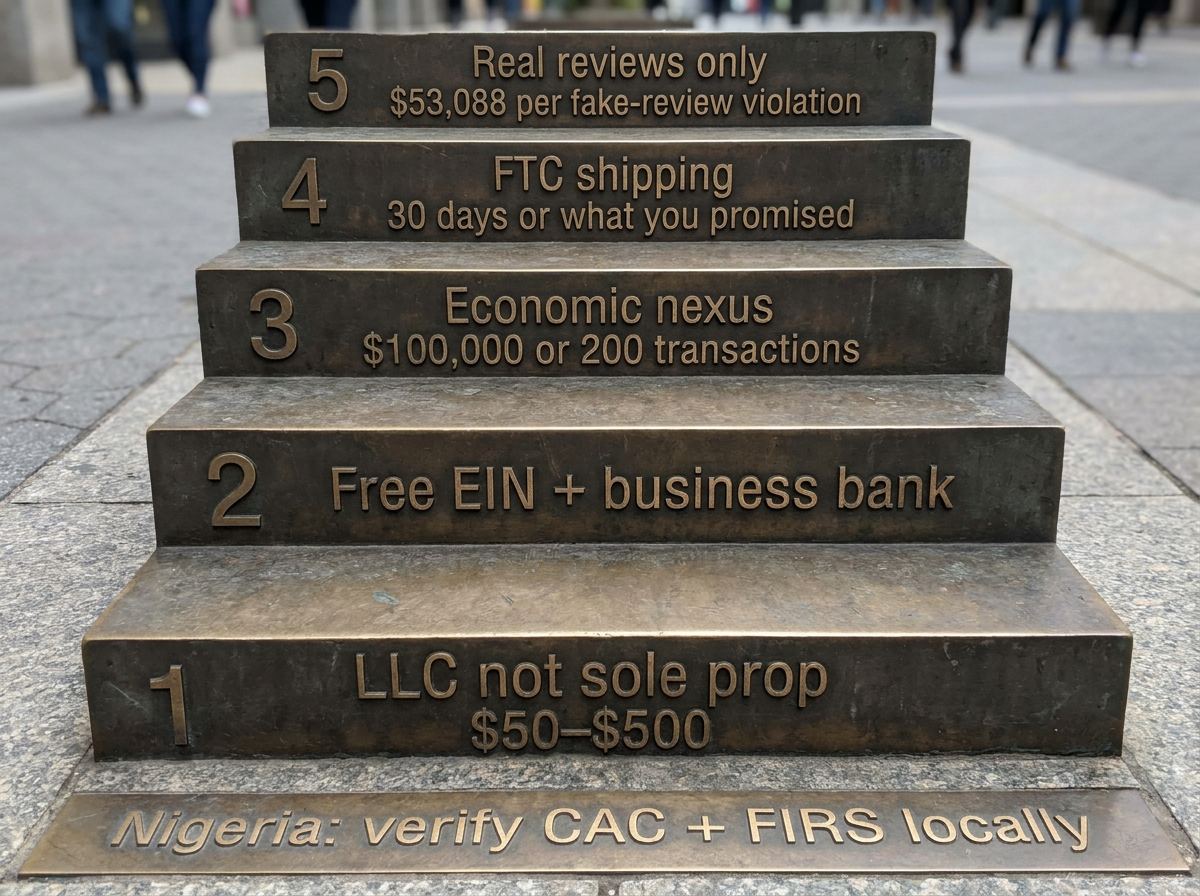
Business structure. In the US, most solo ecommerce founders choose between a sole proprietorship (simple, no separate legal entity, all liability is personal) and a single-member LLC (separate entity, limited liability, a bit more setup). Both are workable. The LLC is smarter.
If you're serious about the business, go LLC. Setup cost is low — typically $50–$500 in state filing fees — and the liability protection is worth it. Outside the US, get local advice; the equivalent entity varies by country.
EIN and business bank account. In the US, get an Employer Identification Number (EIN) from the IRS — free, takes about five minutes online. Open a dedicated business bank account immediately. Mixing personal and business money is how you lose the LLC's liability protection and make tax time a nightmare.
Sales Tax, VAT, and Economic Nexus
This is the one that surprises most new founders.
In the US, many states require you to collect and remit sales tax once you exceed $100,000 in revenue or 200 transactions in that state — this is called economic nexus. You don't have to be physically present to trigger it. Most new stores won't hit these thresholds in year one, but you should know they exist.
Automation tools like TaxJar and Avalara charge roughly $19–$99/month depending on volume and states. Stripe Tax is another option, integrated directly into your payment flow.
For EU sales: GDPR applies to any data you collect on EU residents, regardless of where your business is registered. Non-compliance fines can reach 4% of global annual revenue. That's not hypothetical — the EU has fined companies far smaller than you'd expect. If you're selling into Europe, set up a GDPR-compliant privacy policy, cookie consent, and a data deletion mechanism before you take your first EU order.
Key Regulations to Know Before Launch
FTC Mail/Internet Order Rule (US): If you make any claim about shipping speed, you must have a reasonable basis to back it up. If you can't ship within 30 days (or the time you stated), you must notify the customer, provide an updated estimated date, and give them the right to cancel with a full refund. This isn't optional.
FTC Reviews and Testimonials Rule (2024): As of October 21, 2024, fake reviews, undisclosed incentivized reviews, review suppression, and misuse of testimonials are explicitly prohibited. The FTC cited civil penalties of up to $53,088 per violation in its December 2025 warning letters. If you're collecting reviews — and you should be — make sure they're genuine, uncoerced, and unedited.
High-risk product categories: Supplements, medical devices, CBD, children's products, food — these carry additional regulatory requirements. Check before you list anything in a category that touches health, safety, or children. The Funnelish guide includes a useful table of US product categories and corresponding regulatory bodies.
A note for Nigerian and African founders: Local requirements vary significantly by country and are outside the scope of this guide. Before operating commercially, verify your obligations with a local attorney or accountant — particularly around CAC registration (Nigeria), local tax obligations (VAT, withholding tax), and customs/import regulations for physical goods sourced internationally. Mark this as a must-verify step before launch.
Pick Your Platform and Channels
The platform question has a simple answer and a complicated one.
Simple: start with Shopify or Amazon. Between them, they power the majority of new ecommerce businesses for good reason.
Shopify gives you full control over your brand and customer relationship. Amazon gives you access to existing traffic and trust.
Most serious brands eventually use both.
Complicated: the best platform is the one that fits your model, your market, and your willingness to manage it.
Platform Comparison
| Platform | Entry Cost | Pros | Cons |
|---|---|---|---|
| Shopify | ~$29/month + apps | Full brand control, strong integrations, huge ecosystem | You're responsible for driving traffic |
| Amazon | $39.99/month + referral fees | Massive existing traffic, built-in trust | Thin margins, no customer relationship, fee complexity |
| Etsy | $0.20/listing + 6.5% transaction | Low barrier, built-in audience for handmade/vintage | Platform risk, limited brand control |
| WooCommerce | Hosting cost (~$5–$20/month) | Open-source, flexible, no monthly platform fee | Technical setup required, slower to launch |
| BigCommerce | ~$29–$299/month | Good for larger catalogs, multi-channel sync | Steeper learning curve |
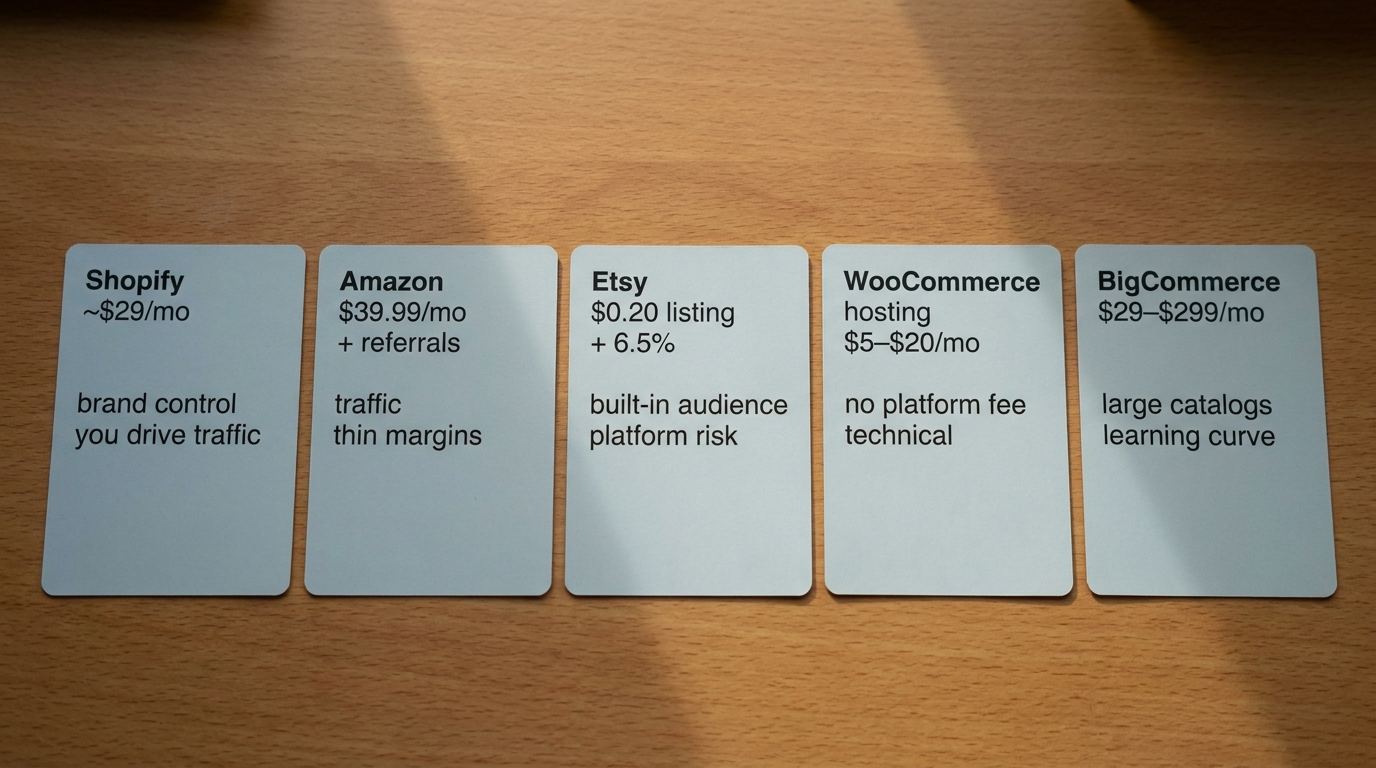
Source: EcomProfits platform comparison, Shopify guidance, Amazon seller plan pricing.
Shopify's $29/month entry plan covers the basics — product listings, a checkout, basic analytics. You'll likely need apps for email ($20–$45/month for Klaviyo's starter tier) and customer reviews (free tiers available), plus potentially a paid theme ($200–$400 one-time). Build the app stack slowly. It's easy to reach $150/month in platform overhead before you've made a single sale.
Amazon's Professional selling plan costs $39.99/month plus a category-dependent referral fee on every item sold. Referral fees range from 6% to 45% by category. For a consumer product at $30, expect to pay 15% ($4.50) on top of the monthly fee.
The math works when your margins can absorb it. It doesn't work for thin-margin products.
Emerging-Market Specifics
If you're based in Nigeria or another African market and selling to local customers, the global platforms still work — but local payment gateways are non-negotiable.
Paystack and Flutterwave are the two dominant payment infrastructure providers in Nigeria, supporting card, bank transfer, USSD, and mobile money. Paystack (acquired by Stripe in 2020) integrates with Shopify via third-party plugins. Flutterwave has direct integrations with several platforms. Many Nigerian customers don't have international cards — a checkout that only accepts Visa/Mastercard without a local bank option will lose them at payment.
For marketplace sales to Nigerian consumers, Jumia and Konga carry existing traffic and trust — similar to how Amazon functions in the US. Same trade-off: platform fees and limited brand control, in exchange for not having to build your own traffic from scratch.
Build a Lean, Conversion-Ready Store
The goal at launch is not a perfect store. It's a store that loads fast, earns trust, and makes buying feel obvious.
Most first stores fail not because of bad products but because of bad product pages. Blurry photos. Vague descriptions. No answer to "why should I trust you." A checkout that looks like it might steal a card number.
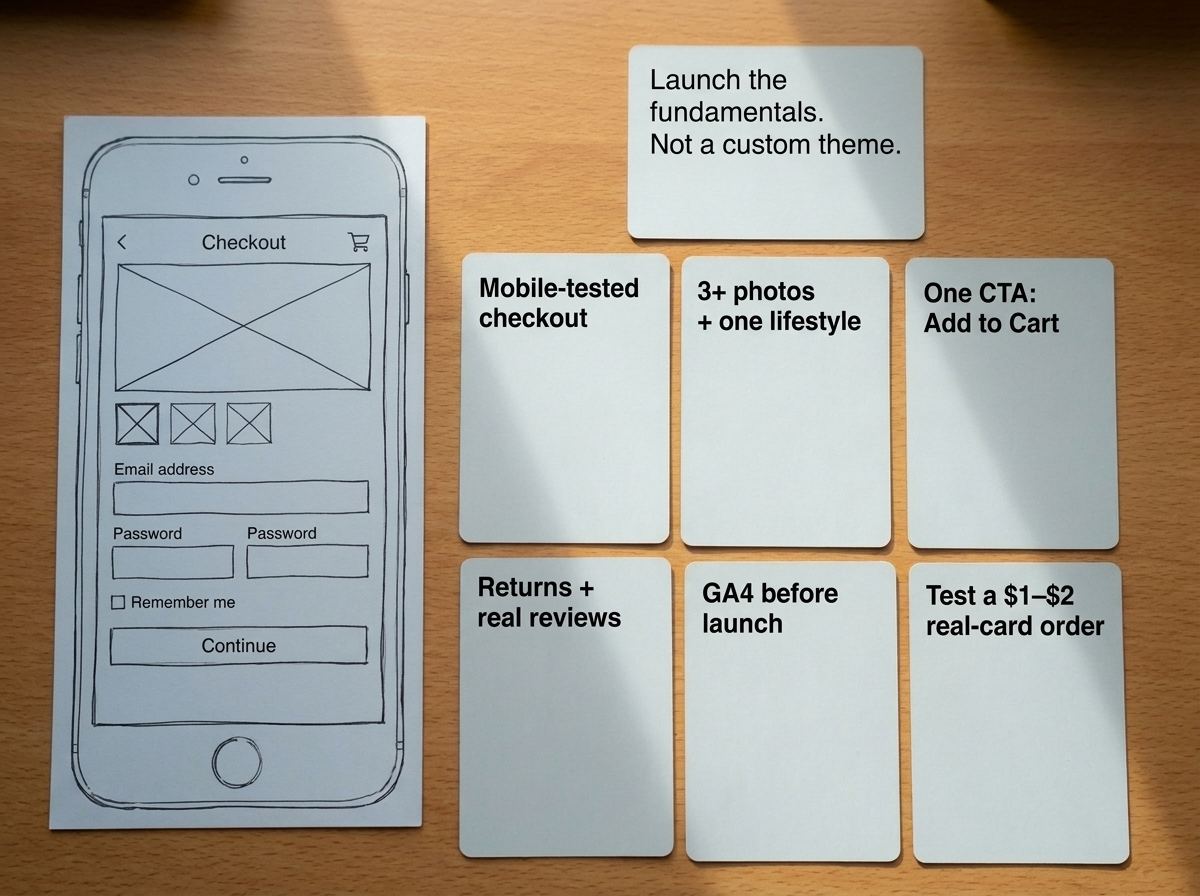
You don't need a custom design. You need the fundamentals executed cleanly.
MVP Store Launch Checklist
Work through this before you drive traffic:
- Product page essentials: Over 70% of ecommerce traffic arrives on mobile. Test every page on a phone before going live. A broken mobile checkout means near-zero conversion rate.
- Product page essentials: at least 3 high-quality photos (one lifestyle shot in use), a clear headline stating what the product does, bullet benefits, visible price, and a single primary CTA — Add to Cart or Buy Now, not both.
- Trust signals: clear return/refund policy, real customer reviews (even 5–10 early ones help), contact email, and an About page with a real person behind the store.
- Shipping policy: be explicit. "Estimated 7–14 business days" is better than "ships soon." Vague shipping claims invite FTC scrutiny and customer complaints.
- Analytics: install Google Analytics 4 and your platform's native analytics before launch.
- Test checkout with a real card. Run a $1–$2 test transaction before you go live. This is the step most people skip and regret.
- Domain: buy your own. A storename.myshopify.com URL signals "I'm not sure this is real." A .com (or .ng, .co.uk) costs $10–$15/year and looks professional immediately.
AI-Ready Platform Considerations
The best platforms in 2026 aren't just storefronts — they're systems you can integrate with AI tools to cut the manual work that kills solo founders.
Shopify's ecosystem now includes Shopify Magic (AI-generated product descriptions and email copy), and the platform's API supports tools like Klaviyo (AI-driven email segmentation), Gorgias (AI-assisted customer support), and Tidio (AI chatbot for instant responses). You don't need all of these at launch. Build on a platform whose architecture supports them — so adding automation later doesn't require rebuilding your store.
Set Up Fulfillment and Shipping That Won't Get You Fined
Shipping is where customer expectations and operational reality collide.
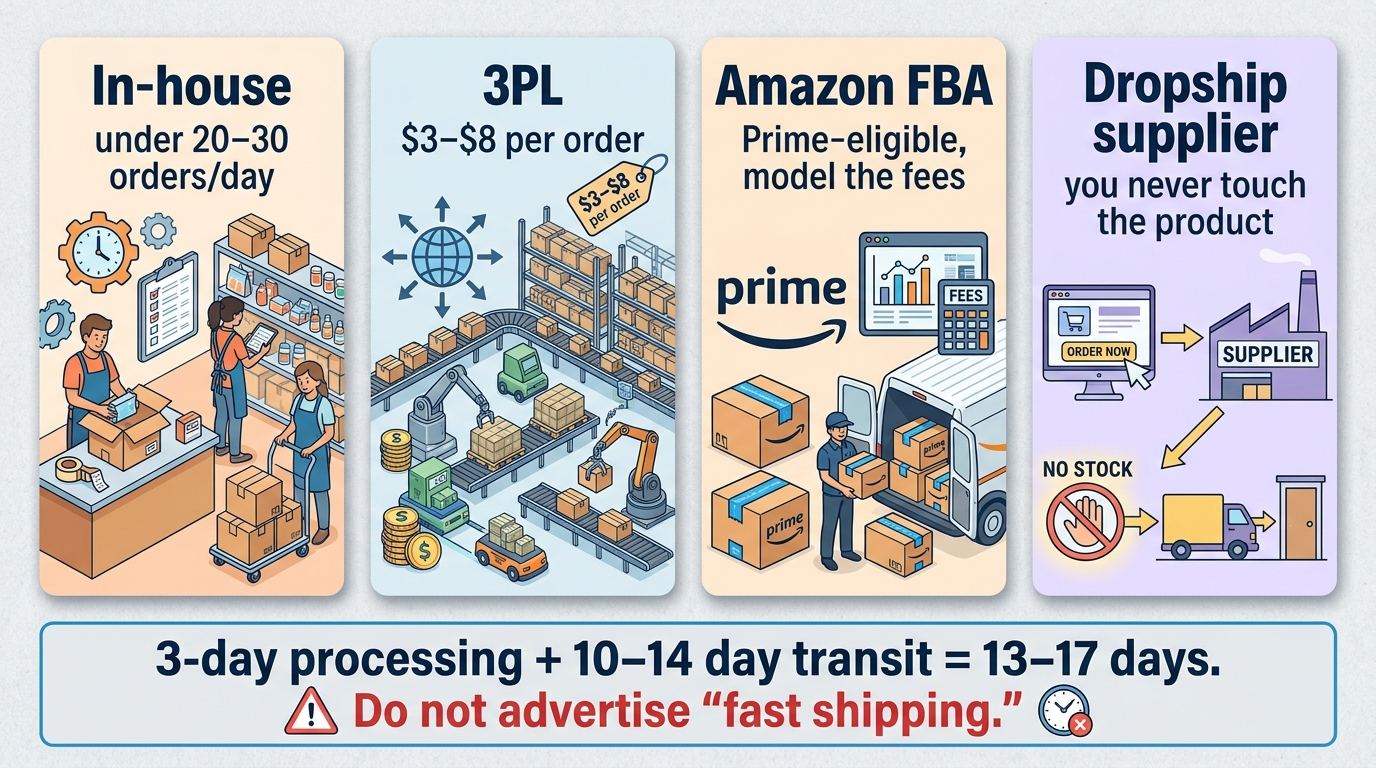
Most new founders underestimate fulfillment complexity. They assume a supplier ships fast, or that "processing time" and "shipping time" are the same thing. They're not. A supplier with a 3-day processing time plus 10–14 days of shipping equals a 13–17 day wait before the customer has the product — and if you advertised "fast shipping," you now have an FTC problem.
Your main fulfillment options:
In-house fulfillment means you pack and ship from home or a small space. Fine at low volume (under 20–30 orders/day). Breaks down fast as you scale.
Third-party logistics (3PL) means you send inventory to a fulfillment center; they pick, pack, and ship. Expect $3–$8 per order for a small operation. The benefit: consistent shipping speeds you can actually advertise.
Amazon FBA stores, picks, packs, and ships your inventory. Products become Prime-eligible — a real conversion lift. The fees are substantial (fulfillment fees, storage, referral fees) and have risen year over year. Model them carefully before committing.
Dropshipping suppliers ship directly from their warehouse. You never touch the product. The trade-off: limited control over packaging, shipping times, and quality.
Shipping Strategy Basics
Set your shipping pricing strategy before launch:
- Free shipping thresholds (e.g., free shipping over $50) increase average order value (AOV) but reduce margin on smaller orders. Model this against your actual shipping cost.
- Flat-rate shipping is simple and predictable. Good for stores with consistent product sizes and weights.
- Real-time calculated rates are most accurate but can confuse customers at checkout if the rate feels higher than expected.
Whatever you choose: state it explicitly on every product page and again at checkout. A customer who reaches checkout and sees an unexpected shipping fee has a very high abandon rate. That's money leaving your funnel at the worst possible moment.
On the FTC rule: if you state or imply a shipping time, you must have a reasonable basis to meet it. If you can't ship within 30 days (or whatever you advertised), you must proactively notify the customer, give them a revised date, and provide a prompt refund if they cancel. This is a binding rule with enforcement.
Automation and AI: Building Your "Invisible Team"
The solo founder's biggest problem is not money. It's time.
There are only so many hours in a day. If you're doing customer support, writing product descriptions, setting up email sequences, updating inventory, and running ads manually — you will hit a ceiling fast. Either the business stalls, or you burn out. Usually both.
The solution isn't hiring a team on day one. It's automating the repetitive work so your hours go to decisions, not tasks.
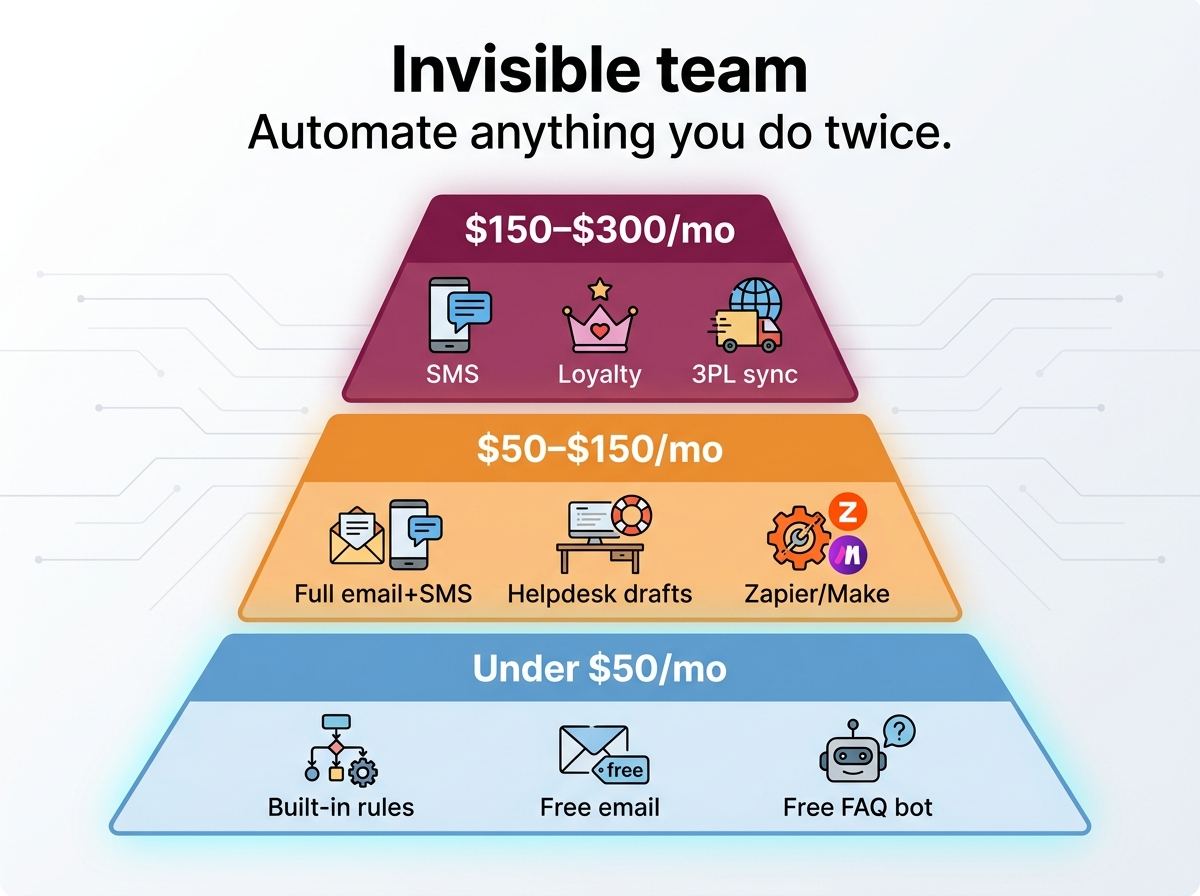
The principle: automate anything you do more than twice that follows a consistent pattern. Most of the stack below is under $100/month for a new store.
Example Automation Stack by Budget
Under $50/month: Shopify's built-in automation rules, Klaviyo's free tier (abandoned cart, welcome series, post-purchase flows), and Tidio's free AI chatbot to handle FAQ tickets before they reach your inbox.
$50–$150/month: Klaviyo Starter (~$45/month) for full email + SMS flows and segmentation; Gorgias Starter (~$10/month) for a centralized helpdesk with AI draft replies; Zapier or Make (~$9–$29/month) to connect platforms that don't natively communicate.
$150–$300/month: Add SMS (Postscript or Klaviyo SMS), a loyalty/referral app (Smile.io), and a 3PL integration that auto-syncs inventory. At this stage, the automation stack is largely running itself.
Simple "Agent" Workflows
Beyond traditional automation, AI-native workflows are genuinely useful for solo founders in 2026.
Review summarizer. Feed your weekly reviews into an AI tool with a prompt: "Summarize recurring complaints and compliments in these reviews in 3 bullets each." Product intelligence without reading 50 reviews manually.
Product description drafts. AI generates first drafts; you provide the product name, features, and target customer, then edit for accuracy and voice. Cuts writing time from 45 minutes per product to 10.
Support ticket routing. With Gorgias + AI assist, common "where is my order?" tickets are auto-answered. Complex tickets — damaged product, payment dispute — get flagged for your attention. You respond to fewer tickets, faster.
Important caveat: AI-generated content and auto-responses need human oversight. A confusing AI response to a billing issue can cost you a customer. Review AI output on high-stakes interactions — support, refunds, disputes — before setting them to fully automated.
The goal is not to remove humans from the business. It's to free your judgment for the decisions that require it.
Traffic, Marketing, and Your First 90 Days Plan
The most beautifully built store with no traffic is a store with no revenue.
Marketing is where most founders get stuck — not because there aren't enough channels, but because there are too many.
TikTok. Instagram. Google Ads. SEO.
Pinterest. Email. Influencer. Marketplace.
Paralysis of choice produces mediocre effort across five channels instead of focused effort on one.
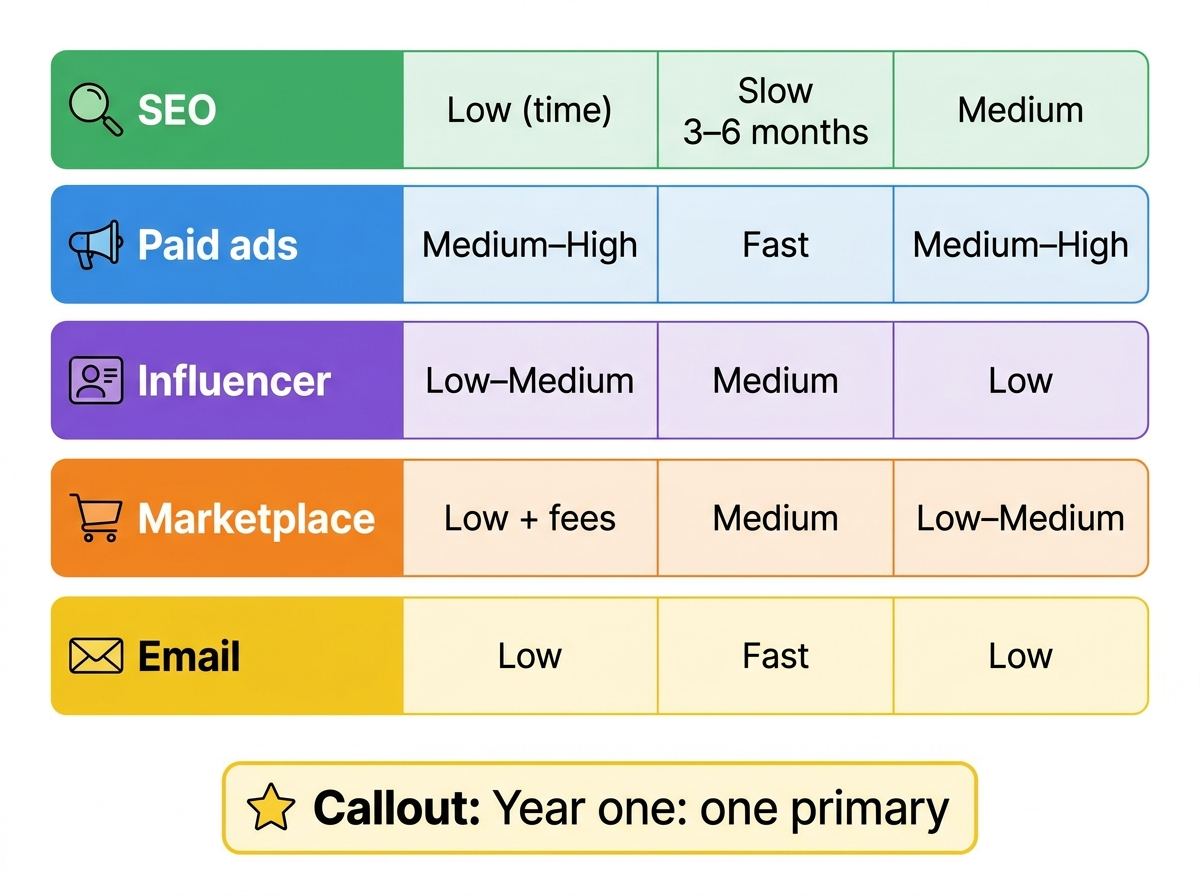
Year one rule: one primary channel, deeply. Understand it. Be consistent on it. Measure it. Then, once it's working, add a second.
First 90 Days Plan
Days 1–30: Launch MVP and build the foundation.
Finalize product, supplier, and landing page. Set up your platform, Google Analytics, and email tool. Write 3–5 product descriptions, homepage, About page, Shipping policy, Returns policy.
Set up abandoned cart, welcome, and post-purchase email flows before a single customer arrives. Publish 2–3 pieces of content on your primary channel.
Days 31–60: Pick one acquisition channel and commit.
Low budget + no ad experience → organic TikTok or Instagram. Low budget + some following → influencer seeding (10–20 micro-influencers, product for honest posts).
$500–$1,000/month budget → Meta or TikTok ads with a narrow audience test. Patient, long-term thinking → SEO content targeting "best [product]" and "how to [problem]" keywords.
Build your email list from day one.
Days 61–90: First sale from a stranger, then first repeat sale. If no sale yet: tighten the product page (photo, headline, CTA), review pricing, watch 5 real people try to buy on your site. Once you have the first stranger sale: trigger your post-purchase flow, shipping update, and review request 7 days post-delivery. First repeat sale is the real goal — proof the product or experience earns loyalty without a paid ad.
Channel Comparison
| Channel | Cost | Speed to Sale | Skill Required |
|---|---|---|---|
| SEO content | Low (time) | Slow (3–6 months) | Medium |
| Paid ads (Meta/TikTok) | Medium–High | Fast | Medium–High |
| Influencer/UGC seeding | Low–Medium | Medium | Low |
| Marketplace (Amazon/Etsy) | Low + fees | Medium | Low–Medium |
| Email list | Low | Fast (existing list) | Low |
One final note: Shopify and multiple industry sources consistently advise giving an ecommerce business 18–24 months of runway before judging whether it's working. Your first 90 days are not meant to produce a profitable business. They're meant to produce your first verified sale and your first real customer insight. Everything else builds on that.
Metrics, Optimisation, and When to Scale
Most new founders track the wrong thing: revenue.
Revenue is a lagging indicator — it tells you what already happened. The metrics that let you see what's about to happen, and where the business is breaking, live in your funnel.
Here are the numbers that matter, and what to do when they're off.
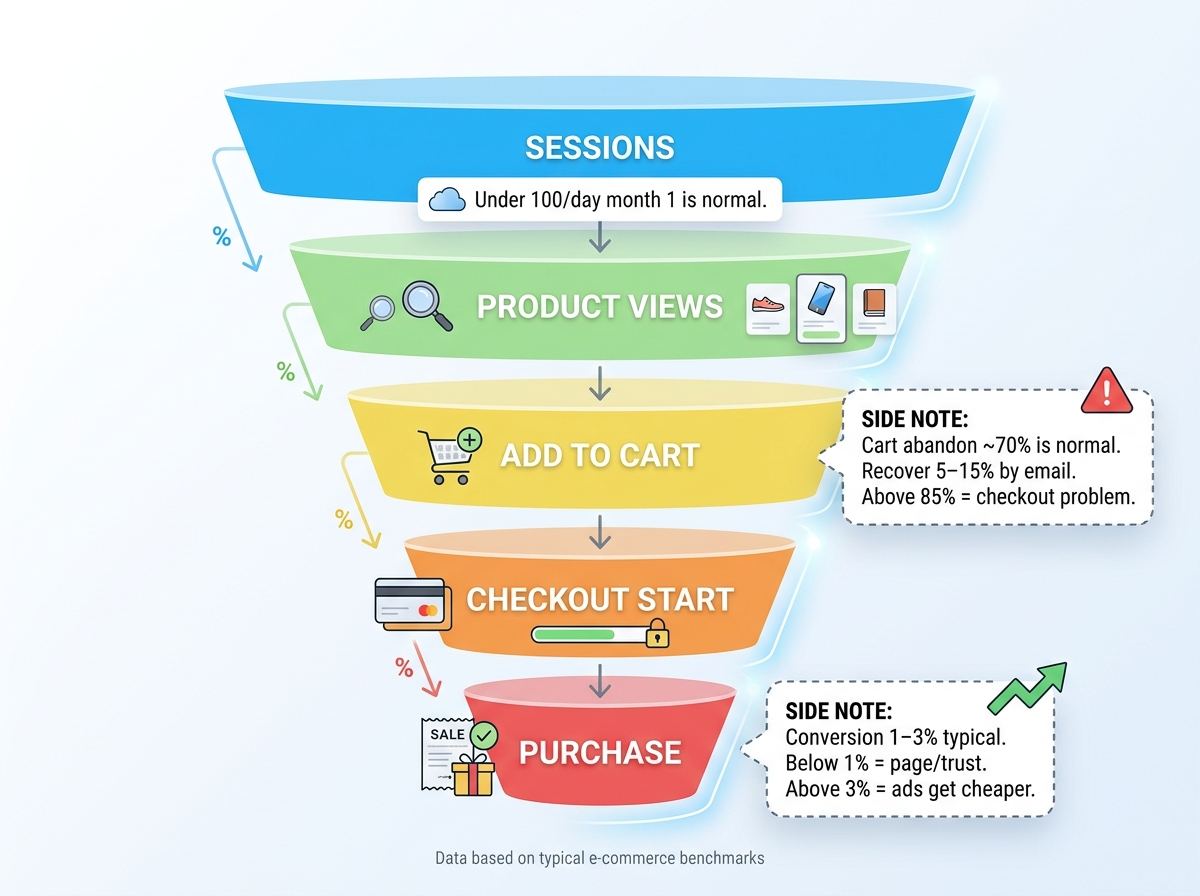
Conversion rate: of every 100 people who land on a product page, how many buy? Industry average is roughly 1–3%. Below 1%: something is wrong with the page, pricing, or trust signals. Above 3%: paid traffic becomes more economical.
Average order value (AOV): the average revenue per transaction. Increase this with bundles, upsells, and free-shipping thresholds.
Customer acquisition cost (CAC): total marketing spend divided by number of new customers. If CAC exceeds contribution margin on a first order, you're buying customers at a loss. That only works if lifetime value (LTV) covers it — which requires repeat purchases.
Contribution margin per order: revenue minus all variable costs (landed cost, payment fees, shipping, returns). This number must be positive. If it isn't, volume won't save you.
Repeat purchase rate: what percentage of customers come back for a second order? For consumable products (supplements, food, beauty), a repeat rate below 20% in year one signals a product quality or post-purchase experience problem.
Cart abandonment rate: typical rate is 70%. Normal. Your abandoned cart email sequence should recover 5–15% of those. Above 85%: check for an unexpected shipping cost or payment friction at checkout.
Simple Funnel View
| Stage | What to Look For |
|---|---|
| Sessions | Are you getting meaningful traffic? Under 100/day in month 1 is normal; scaling ads with no traffic is impossible |
| Product views | If sessions are high but product views are low, your homepage/category page isn't directing people |
| Add to cart | Low add-to-cart rate → product page problem (photos, copy, price) |
| Checkout start | High add-to-cart but low checkout start → shipping cost reveal or trust gap |
| Purchase | High checkout start but low purchase → payment friction, trust at final step |
When to Scale vs When to Pause
Shopify's guidance is to give a store 18–24 months before concluding it's not working. That's not a license to ignore bad signals — it's a reminder that a store needs time to compound: more reviews, more SEO authority, more return customers.
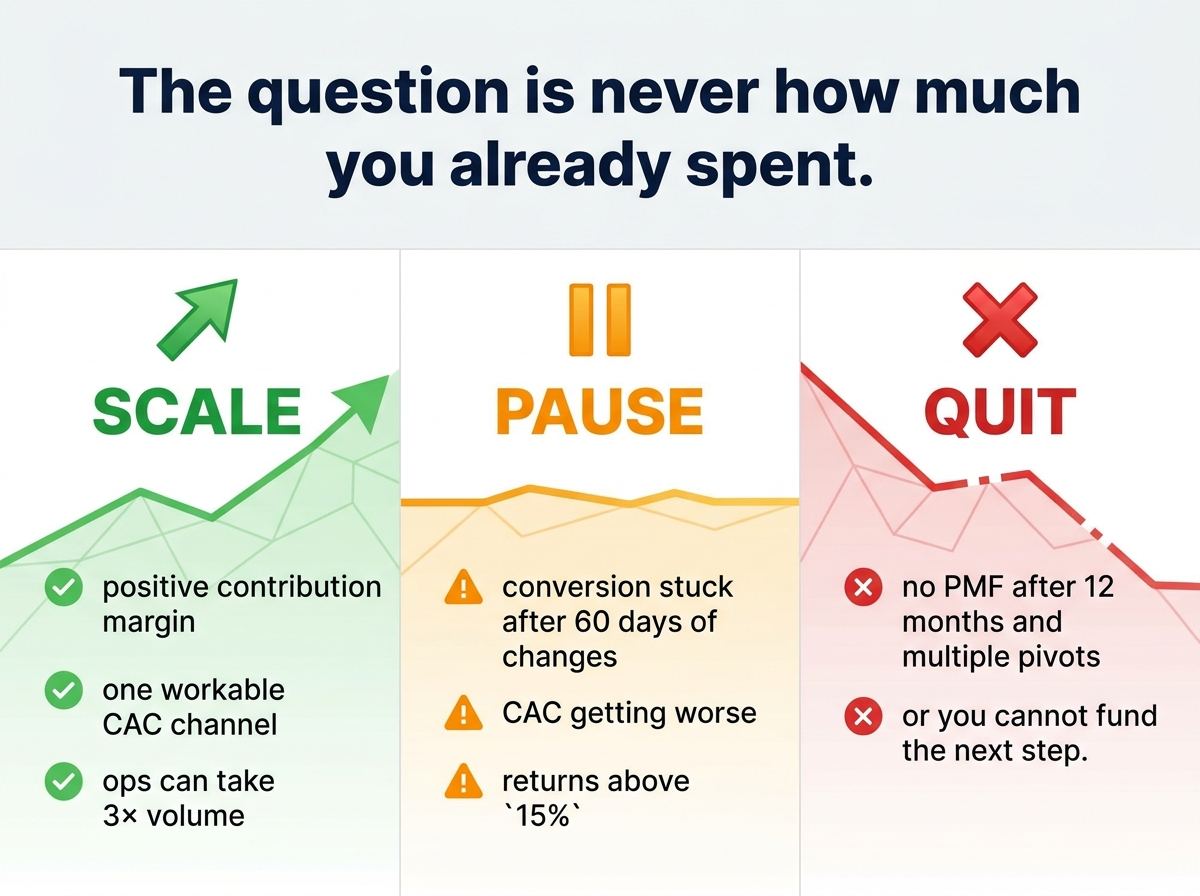
Scale when: you have a positive contribution margin per order, at least one channel showing consistent sub-breakeven or profitable CAC, and your operations (fulfillment, support) can handle 3× current volume without collapsing.
Pause and diagnose when: conversion rate hasn't improved after 60 days of changes, CAC is accelerating rather than improving, or your product return rate is above 15% (signals a product-expectation mismatch).
Quit when: product-market fit evidence is absent after 12 months and multiple pivots, or you genuinely can't fund the business to its next inflection point.
The sunk-cost fallacy is real in ecommerce. Founders keep pouring money into a store because they've already spent money on it. The question is never "how much have I invested?" It's "does the evidence say this will work if I invest more?"
Region-Specific Notes: Nigeria and Emerging Markets
The guides dominating search results for this keyword are almost entirely US- and EU-centric. For a founder in Lagos, Accra, Nairobi, or Cairo, they're useful — but incomplete.
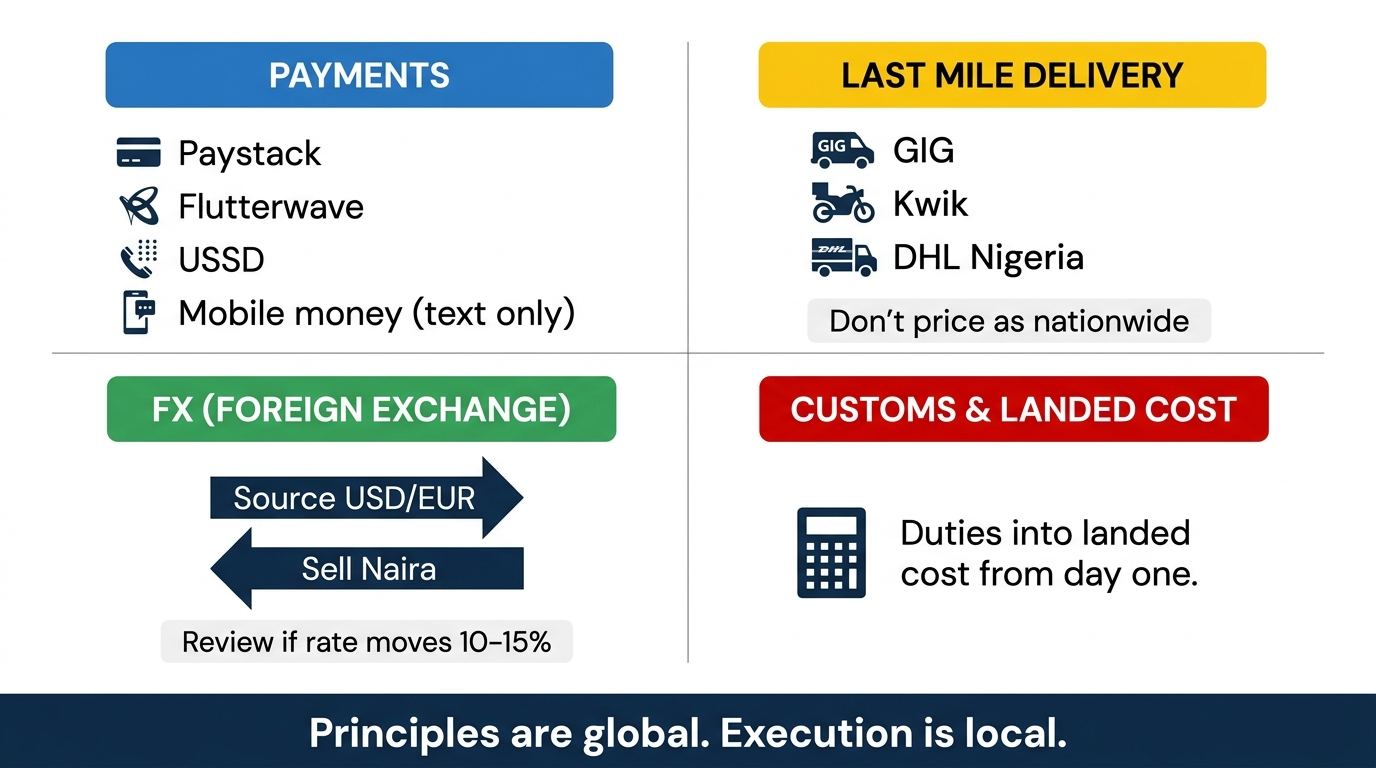
Payments. Getting paid is harder across Africa than the US playbook implies. Paystack and Flutterwave handle local card, bank transfer, USSD, and mobile money. If you're selling to Nigerian consumers, these are not optional integrations — they're requirements. Many Nigerian customers don't have international cards and won't complete a checkout that only accepts Visa/Mastercard without a local bank option.
FX volatility. If you're sourcing in USD or EUR and selling in Naira, your margins move every time the exchange rate moves. Build an FX buffer into your pricing model — at minimum, review your cost structure quarterly and adjust prices when the rate shifts more than 10–15%.
Last-mile delivery. Logistics within Nigeria is solved differently than in the US. Couriers like GIG Logistics, Kwik Delivery, and DHL Nigeria operate in major cities; coverage in smaller cities and rural areas is inconsistent and more expensive. Factor in realistic delivery times and costs by region — not just "nationwide."
Customs and imports. Sourcing products from China, the EU, or the US for resale in Nigeria means import duties, customs clearance delays, and agent fees. These add to landed cost. Build them into your unit economics model from the start.
Local legal requirements (must verify locally): Business registration with the Corporate Affairs Commission (CAC) in Nigeria, FIRS registration for tax purposes, and any sector-specific permits for your product category. This guide cannot substitute for advice from a qualified Nigerian lawyer or accountant — treat this as a checklist to verify, not a compliance guarantee.
The core ecommerce principles are the same everywhere. The execution is local.
Your Next 7 Days
You have the framework. The model comparison. The real cost ranges.
The legal checklist. The platform trade-offs. The automation stack. The 90-day marketing plan.
None of it matters until you make the first decision and act.
Here's what to do in the next seven days:
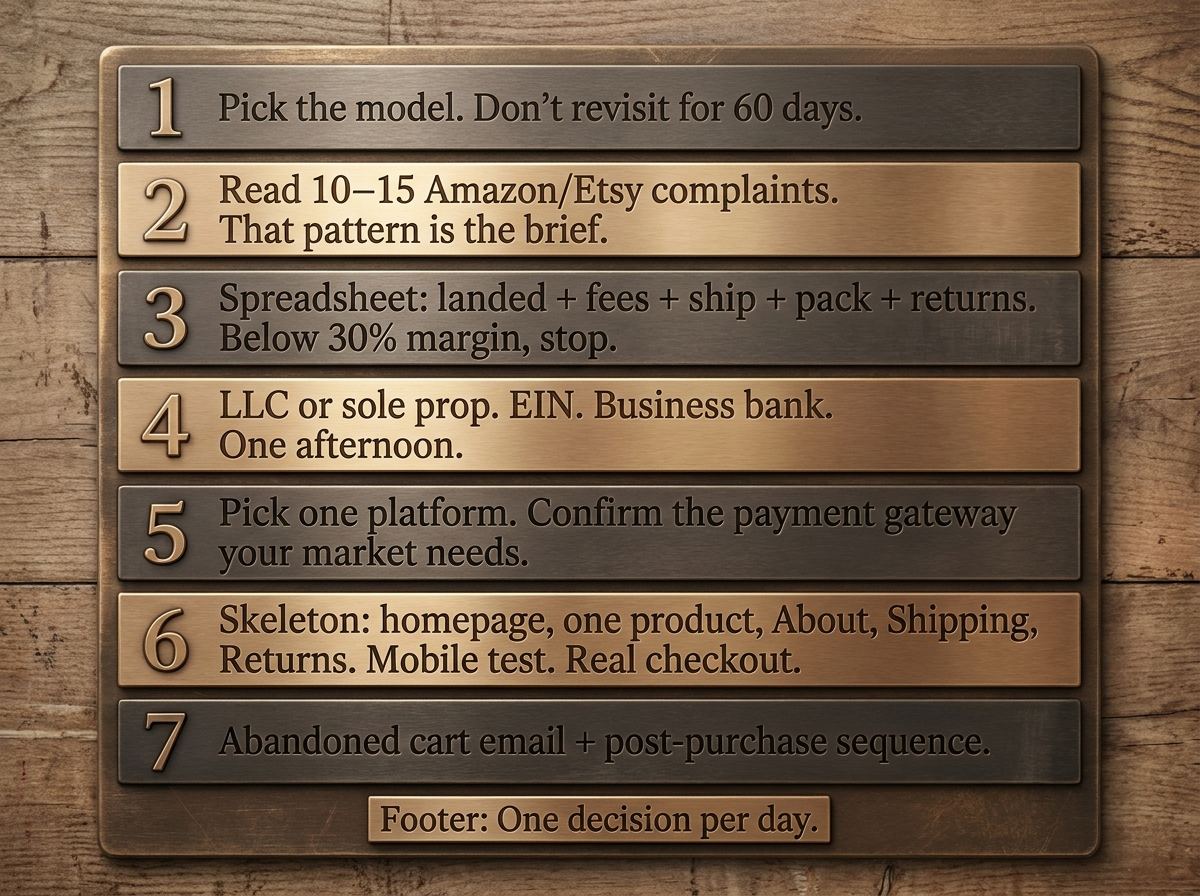
Day 1: Pick your model.
Dropshipping or digital products if your budget is under $2,000. Private label if you have $5,000–$20,000 and six months of patience.
Write it down. Don't revisit it for 60 days.
Day 2: Validate the niche.
Find 10–15 Amazon or Etsy reviews in your target category. List every complaint. Find the pattern. That pattern is your product brief.
Day 3: Map the unit economics. Before you register anything, build the spreadsheet: landed cost + payment fees + shipping + packaging + estimated returns. What does your contribution margin look like at a realistic price? Below 30%, reconsider the product or model.
Day 4: Handle the legal minimum. Choose LLC or sole prop.
Get your EIN if US-based. Open a business bank account. One focused afternoon.
Day 5: Choose your platform. Pick one. Set up the account. Confirm it integrates with the payment gateway your market needs.
Day 6: Build the store skeleton. Homepage, one product page, About page, Shipping policy, Returns policy. Mobile tested. Test checkout completed.
Day 7: Set up your first automation. At minimum: abandoned cart email and a post-purchase follow-up sequence. These run from your first order forward with zero extra effort.
That's seven days. One decision per day.
You don't need everything in this guide done before you launch.
You need the minimum viable version of each layer: a real product, honest numbers, a legal foundation, a platform, and one acquisition channel.
Then run the experiment. Learn. Adjust.
The founders who make it in ecommerce aren't the ones who plan perfectly. They're the ones who ship something real, measure honestly, and iterate faster than they're afraid.
Ready to take this further?
If you've read this far, you have the strategy. What you might need next is someone to build it with you — or for you.
Here's where I can help, depending on where you are right now:
No. 1 — Brand Positioning Intensive. Before you build anything, get clear on your positioning: who you're for, what makes you different, and how to say it in a way that attracts the right customers. This is the work most founders skip — and the reason most stores blend into the background. If you're still in the idea stage, this is where we start.
No. 2 — Done-For-You Ecommerce Build. If you have a product or idea and you're ready to build, I handle the full technical execution — your store, your integrations, your automation foundations — while you focus on sourcing and marketing. This is the build side of the All-Way-In Approach: not just a delivered website, but a brand with strategy behind it. aboveglobal.ng is one example of what that looks like in practice.
No. 3 — All-Way-In Brand Package. For founders who want both: the positioning work, the full build, and the ongoing coaching through your first 90 days. You get a strategist and a builder in the same engagement. We uncover what makes your brand specific, build the digital foundation, and work through the execution together — so you understand why every decision was made, not just what was built.
If any of these sound like what you need next, reach out directly. No pressure, no funnel. Just a conversation about where you are and whether I can help.
FAQs
How much does it cost to start an ecommerce business in 2026?
Startup costs range from $500–$2,000 for a lean dropshipping or digital products launch, to $3,000–$15,000 for a small DTC brand, to $15,000–$25,000+ for a full private-label play with branded inventory. A $100 technical minimum exists but first-year costs typically reach thousands of dollars.
Which ecommerce model is best for beginners?
Digital products (70–95% margins, $200–$1,000 startup) or dropshipping (10–30% margins, $500–$2,000 startup) are the lowest-barrier entry points. Digital products have the fastest path to first sale — often days — with no inventory risk.
How long does it take to become profitable in ecommerce?
First sale often happens within weeks. Consistent profit typically takes 6–18 months. Shopify and industry guidance recommend planning for 18–24 months of runway before judging success.
Do I need to register a business to start selling online?
Technically no, but practically yes. An LLC (US) or equivalent entity protects personal assets, unlocks business banking, and is required by many payment processors and wholesale suppliers. Setup costs $50–$500 in most US states.