AI SEO 2026: Google's AI Is Already Deciding Who Gets Your Customers — Here's How to Make Sure It's You
AI Overviews now sit above the blue links. Get cited in AI answers, then turn those citations into booked calls — without an enterprise budget.

Cephas Tope
Builder and certified life coach behind Cephastope. I ship the site and coach the strategy — the All-Way-In Approach.
Live work: ABOVE · Handmework · Elenvara · Full bio
You published the guide. You built the backlinks. You watched the position climb.
You ranked number one on Google. And then the traffic flatlined anyway.
If that sounds familiar, you're not doing something wrong. The game changed. Google quietly rebuilt the board — and the move that used to win (rank first, get the click) now sometimes wins nothing at all.
Here's what actually happened. According to multiple 2026 analyses, 68% of Google searches in the US now end without a single click.
Someone types a question, reads the AI-generated answer at the top of the SERP, gets what they came for, and leaves. Your blue link, even at position one, never gets touched.
In Google's newer AI Mode, that number climbs to approximately 93%. Nine out of ten queries. No click.
And yet — AI-referred traffic grew 527% year-over-year between January and May 2025, according to Semrush's published AI search traffic study. People are clicking from AI surfaces. Visitors who arrive from an LLM citation convert at 4.4 times the rate of visitors from traditional organic search, per the same Semrush research.
The traffic is there. The conversions are real. Most businesses have no plan for capturing either.
This guide is that plan.
Not just how to get cited in AI Overviews and LLM answers — but how to turn those citations into booked calls, form fills, and revenue.
Practical steps. Lean budget. No ten-person SEO team required.
Why "AI SEO 2026" Is a Zero‑Click, AI‑First SERP
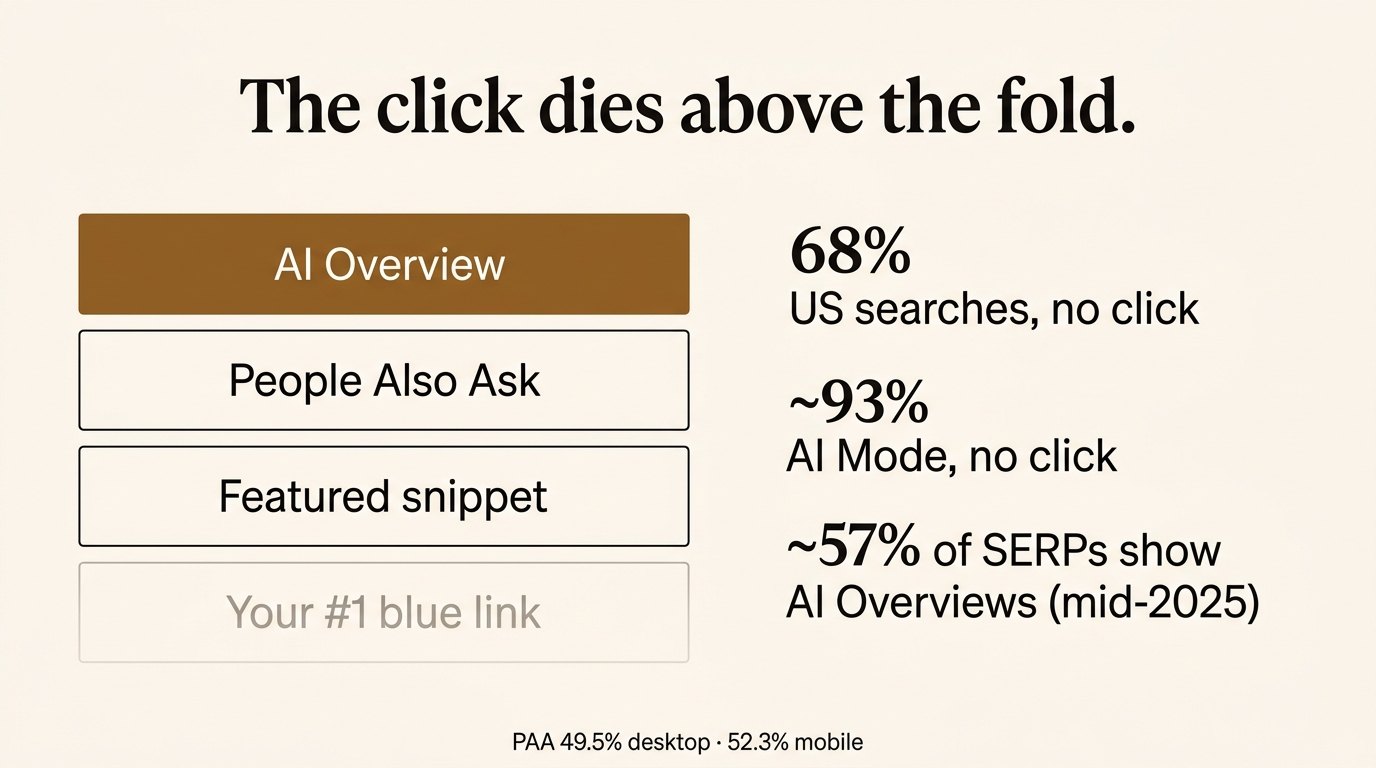
You can rank number one today and get fewer visitors than you got three years ago at position five. Not because your content got worse.
Because the SERP above your link is now dense with machine-generated answers — an AI Overview synthesized from multiple sources, People Also Ask boxes, a featured snippet — before any blue link is visible.
In Google's AI Mode, zero-click rates reach approximately 93%. And yet AI-referred traffic grew 527% year-over-year in the first five months of 2025 (Semrush's AI search traffic study). People are clicking from AI surfaces. Your goal in 2026 is to be the source they click to.
AI Overviews now appear on approximately 57% of Google SERPs as of mid-2025, with higher penetration on informational and how-to queries — exactly the kind this article targets. People Also Ask boxes show up on 49.5% of desktop searches and 52.3% of mobile searches.
If your content isn't structured to be extracted into those answers, you're invisible to the reader who never scrolls to the blue links.
The opportunity sits right inside that problem. Most guides about AI SEO stop at "get cited." Almost none of them show you what to do after — how to turn that citation into a booked call, a form fill, a WhatsApp conversation, or a sale.
What AI SEO Actually Is in 2026 (Beyond Keywords)
AI SEO means optimizing your content to be cited across every AI-powered answer surface competing for your customer's attention: Google AI Overviews, AI Mode, ChatGPT, Perplexity, Gemini, Copilot. Each reads, chunks, and synthesizes content from the web. Your content either makes the cut or it doesn't.
Here's the honest difference between what worked before and what works now:
| Traditional SEO | AI SEO 2026 | |
|---|---|---|
| Primary goal | Rank in ten blue links | Be cited in AI answers + overviews |
| Focus | Keywords, backlinks | Topics, entities, structured content, E‑E‑A‑T |
| Measurement | Rankings, clicks | AI citations, AI share of voice, LLM conversions |
| Surfaces | Google/Bing SERPs | AI Mode, Overviews, ChatGPT, Perplexity, Gemini, Copilot |
| Content format | Keyword‑matched prose | Answer blocks, schema, FAQ, topic clusters |
| Success signal | Position 1 | Citation frequency + branded search uplift |
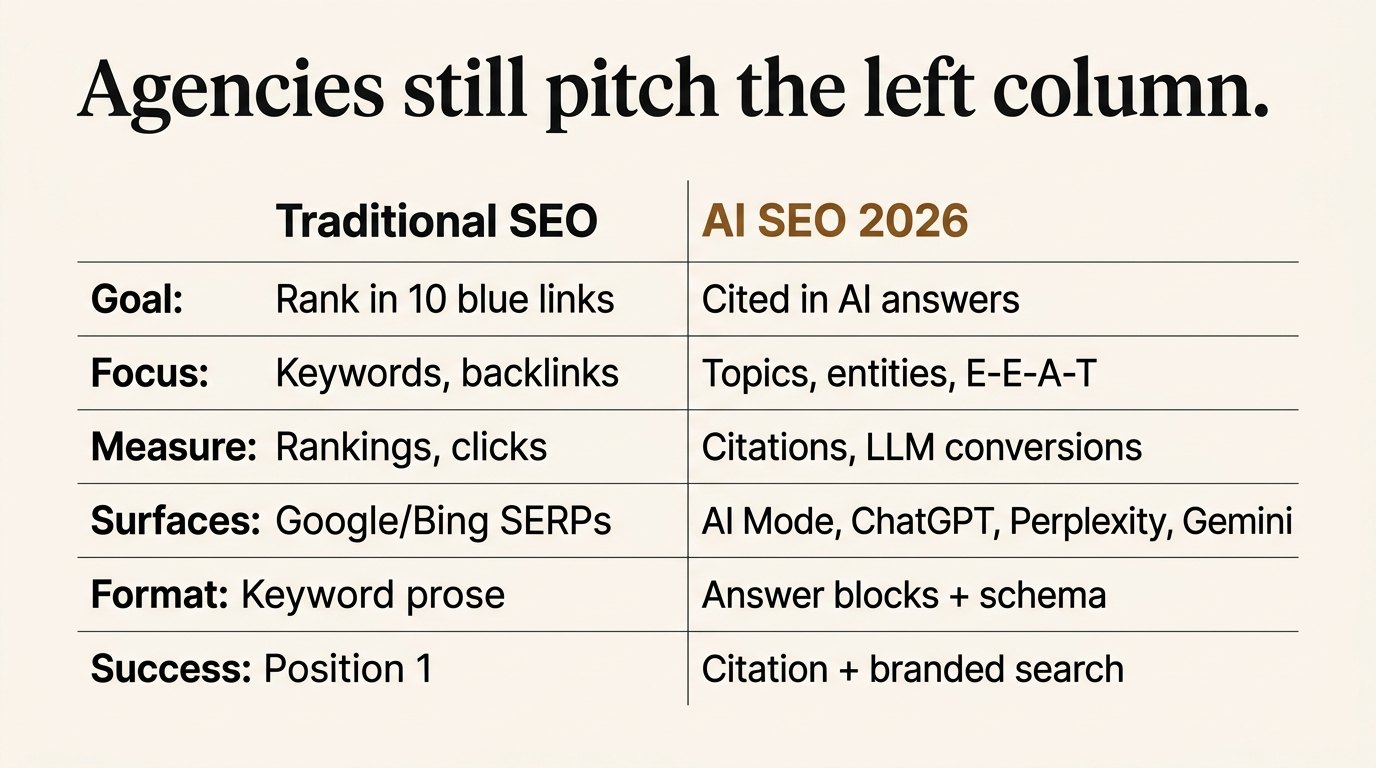
The left column is what most agencies still pitch. The right column is where traffic is moving.
GEO (Generative Engine Optimization) and AEO (Answer Engine Optimization) are built on the same crawlable, trustworthy foundation as classic SEO. The difference is intent: instead of optimizing only for ranking, you're optimizing to be the source an AI model quotes.
Big brands get cited by default. If you're a service business or early-stage founder, you have to earn it intentionally. The rest of this guide shows you how — and how to make money when it happens.
The AI Answer Funnel: From Citation to Cashflow
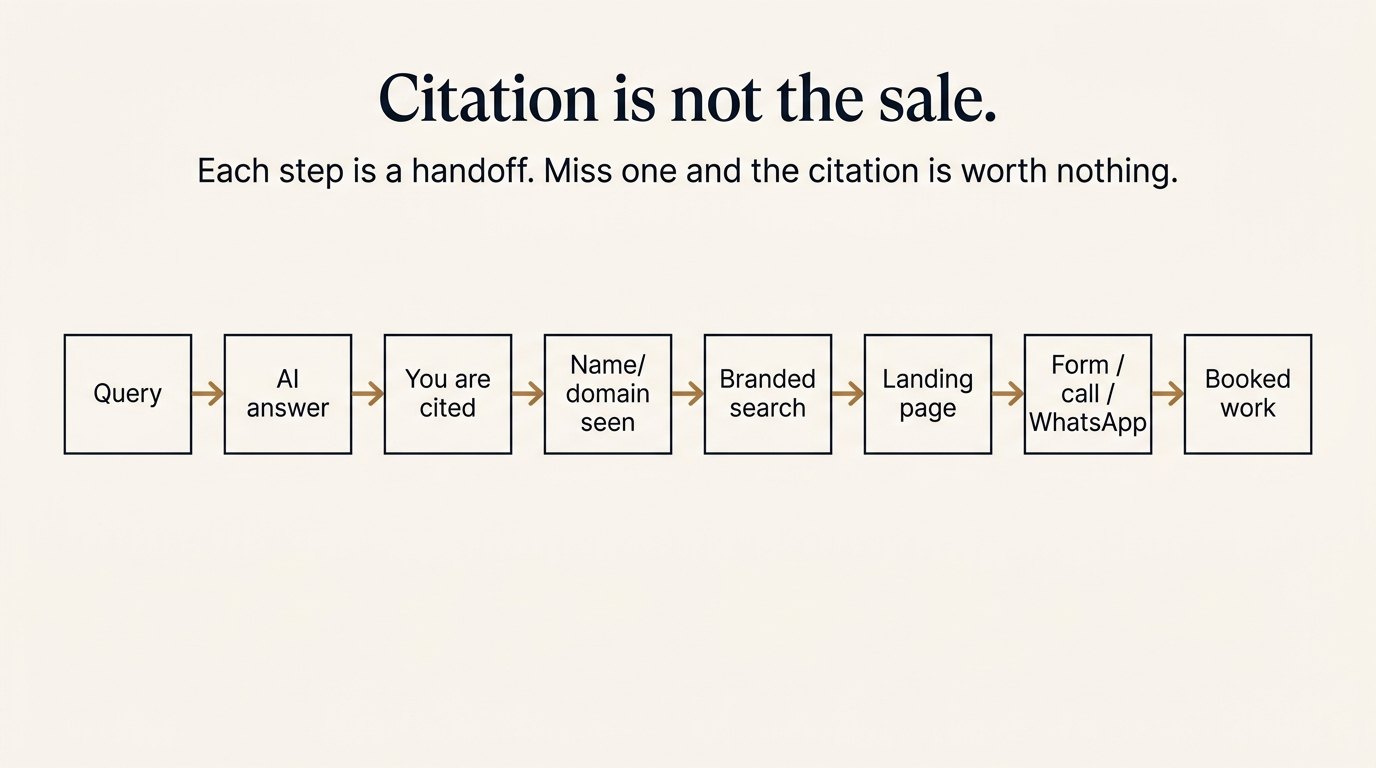
Most businesses get nothing from AI SEO even when they're being cited. Here's why.
They optimize for the citation. They stop there. They have no plan for what happens to the reader after the citation.
Here's what the funnel looks like when it's designed to close:
User query → AI Overview or LLM answer → Your content is cited → Reader sees your name or domain → Branded search or direct click → Dedicated landing page → Micro‑conversion (form, call, WhatsApp, email) → Booked appointment or sale
Semrush's AI search traffic study found LLM-referred visitors convert at 4.4 times the rate of traditional organic search. A Microsoft Clarity analysis showed sign-up conversions of 1.66% from LLM traffic vs. 0.15% from search. A 10x difference in per-visitor value.
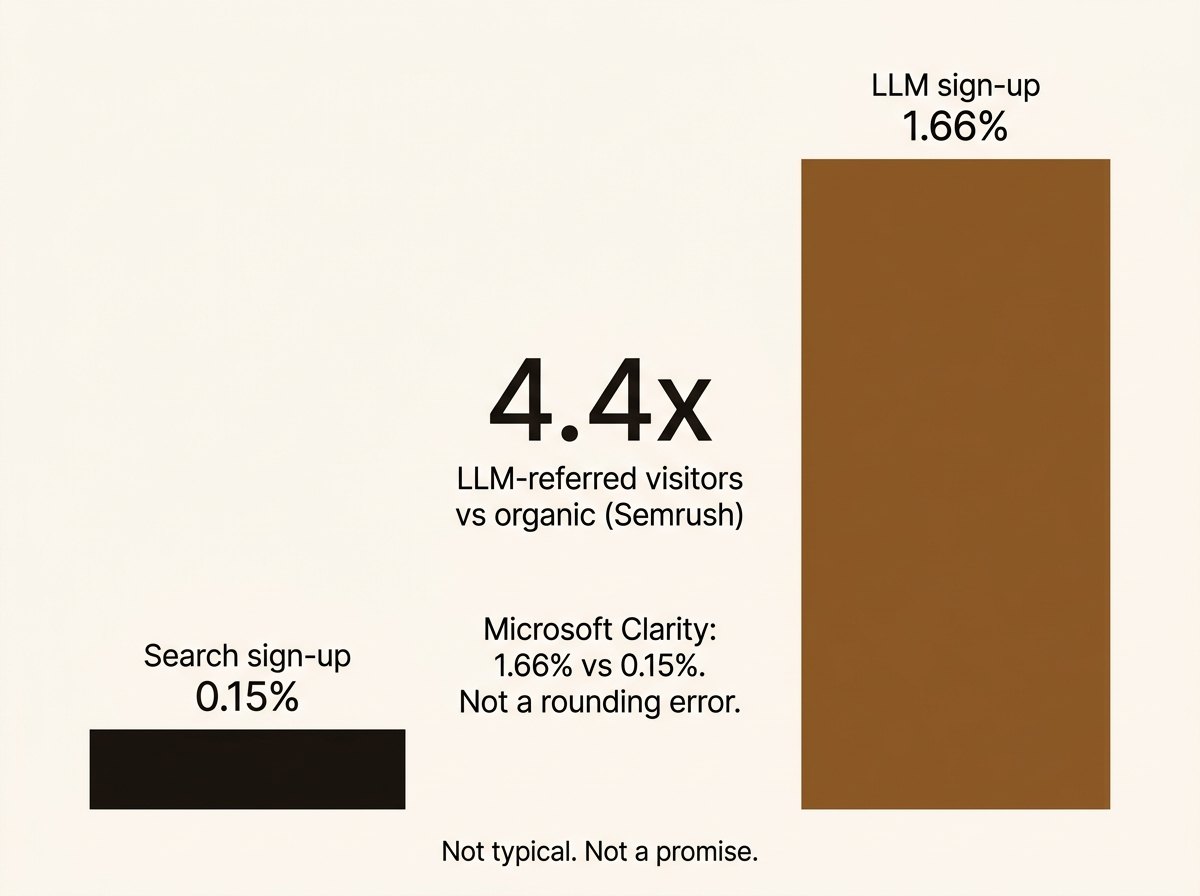
Think about what that means for you. A handful of AI-cited visitors can outperform a thousand ranking-traffic visitors — if you've built the conversion path. Most businesses haven't.
The four moves that make the funnel work:
1. Make your content the source. Direct, structured, attributable answers. Short answer first, then the detail. Exact figures where you have them.
2. Establish brand recall. When an AI Overview says "according to [your brand]," the reader needs something memorable to search next. Your domain and brand name should be consistent and distinctive across every citable page.
3. Build a landing page for AI-sourced visitors. Not your homepage — a page for someone who already has the basics and wants to know if you're the right person to help. One clear action: book a call, fill a form, or chat.
4. Track AI-sourced conversions separately. UTM parameters on any link earning AI Overview placement, plus a separate goal in GA4 for those sessions. If you don't track them separately, you'll never know whether the work is paying off.
The KPIs you actually need: citation frequency (how often your content appears in AI answers), AI share of voice (you vs. competitors), AI-sourced sessions (UTM-tagged from AI surfaces), AI-sourced conversion rate, and revenue per AI session.
One illustration: a B2B SaaS company tracked in Semrush's 2025 study found that despite a drop in organic search clicks, AI-referred sessions increased — and those sessions had a notably higher free trial activation rate. Smaller traffic volume. Higher revenue per session. That's the funnel working.
(Not typical for every business; results depend on your niche, content depth, and conversion infrastructure. This is a reported finding from Semrush's study, not a promise.)
Building an AI‑Ready Content Architecture (Topics, Clusters, and Extractable Answers)
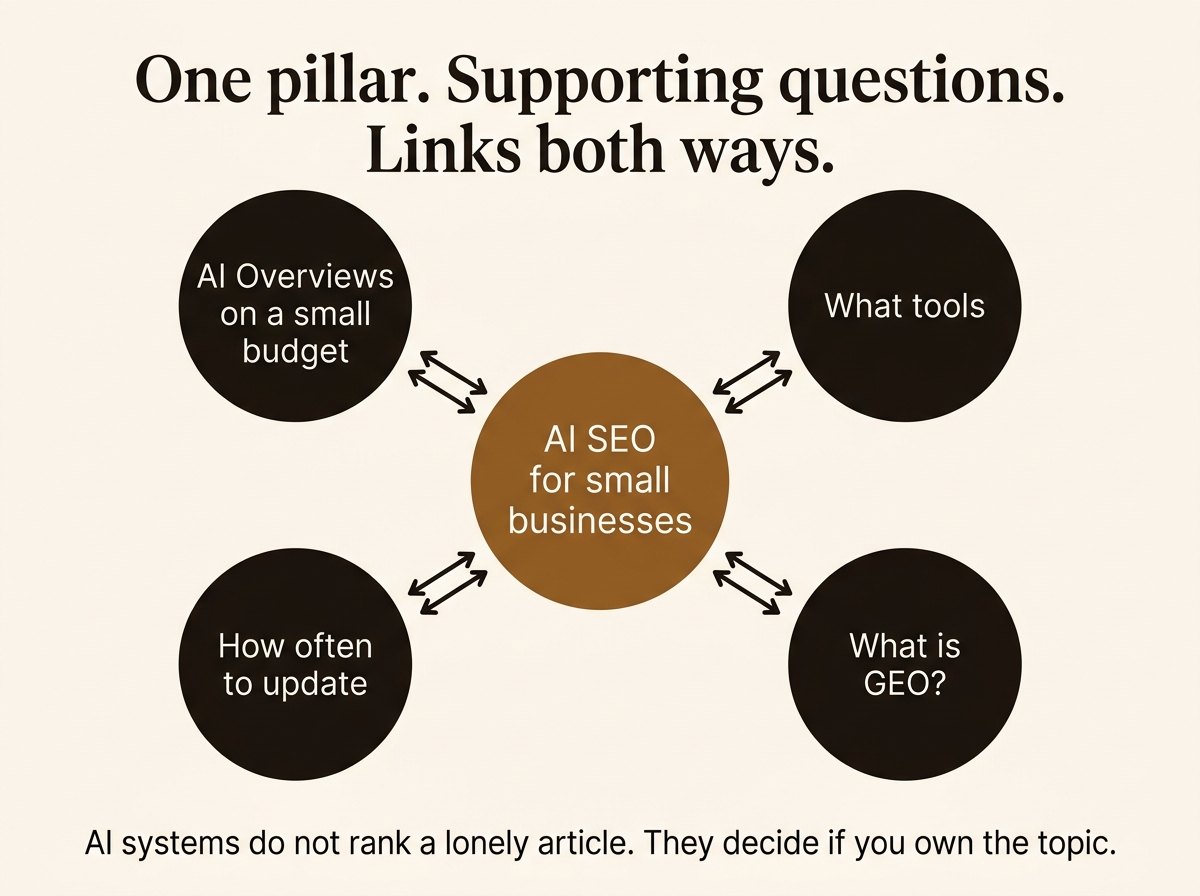
You can't optimize a page in isolation anymore. AI systems don't rank individual articles — they build a picture of whether you own a topic.
Publish one long guide and nothing else, and you might get cited occasionally. Build a topic cluster, and you become the default reference. If the storefront itself is still missing, start lean on the ecommerce side and come back to this cluster once pages can rank.
Start with a seed topic and radiate outward. Your seed topic is the core problem you solve. For a marketing consultant serving SMB founders, that seed might be "AI SEO for small businesses."
Supporting questions become supporting pages: "How do I optimize for AI Overviews on a small budget?" "What tools do small businesses use for AI SEO?" "What is GEO?" Each supporting page links back to the pillar. The pillar links out. The structure signals topical authority to AI systems and crawlers alike.
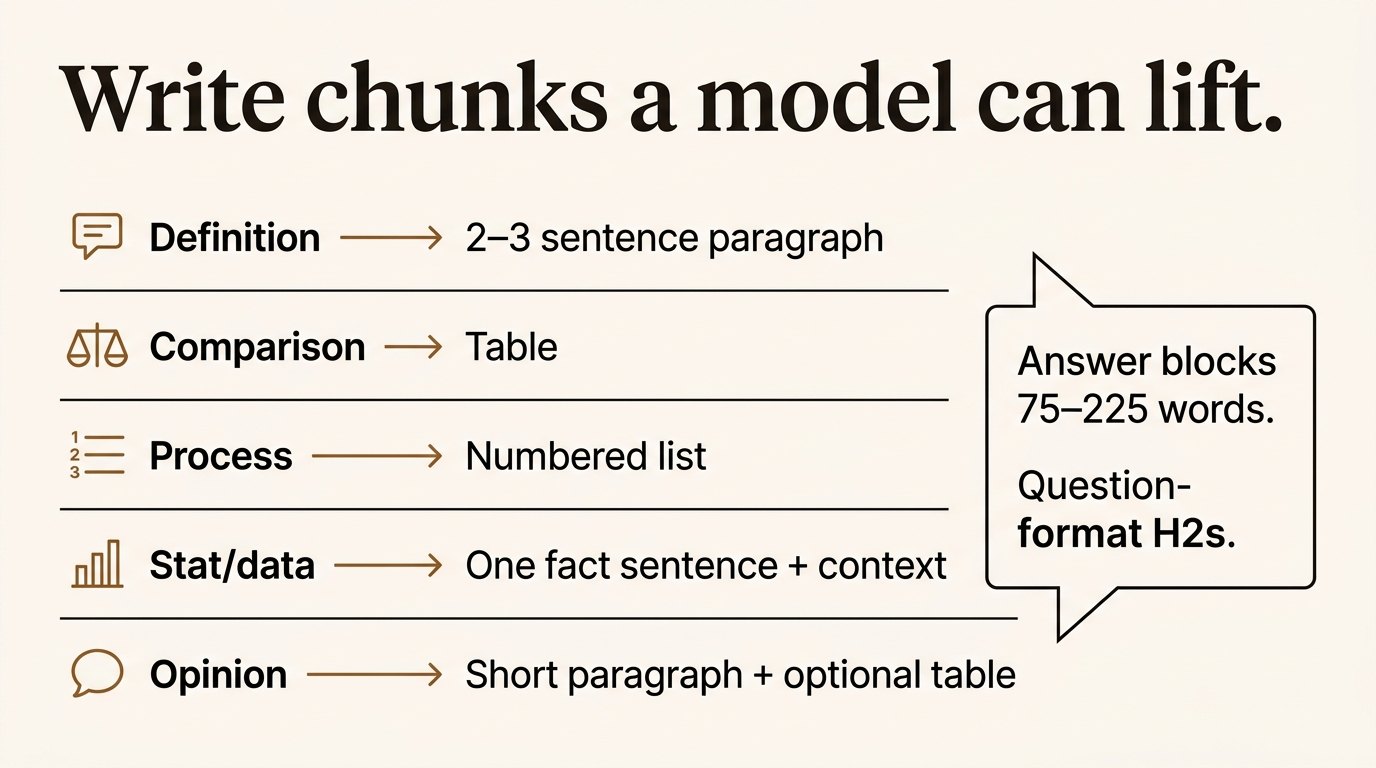
Make your content extractable. AI models chunk content. They pull specific passages that directly answer a question, not full articles. Your job is to write in chunks that can stand alone.
Rules for extractable content: one idea per section; answer first, then explain; keep answer blocks to 75–225 words; use question-format headings ("Is SEO still worth it in 2026?" beats "SEO viability in the current landscape").
Match your format to the question type:
| Question type | Recommended format | Why it works |
|---|---|---|
| Definition ("What is GEO?") | 2‑3 sentence paragraph | Extracted cleanly as a snippet |
| Comparison ("GEO vs SEO?") | Table | Models pull tables for structured comparisons |
| Process ("How to rank in AI Overviews?") | Numbered list | Step clarity is favored for how‑to extraction |
| Stat/data ("How many searches are zero-click?") | Single fact sentence + context | High citation probability for data points |
| Opinion/recommendation ("Best AI SEO tools?") | Short paragraph + optional table | Hedged claims with verifiable support |
A word on FAQ sections. Google deprecated FAQ rich results in May 2026. FAQ schema won't earn a rich snippet anymore. But the structured format still matters for AI extraction — it makes content more parseable by LLMs. Write FAQ sections for the reader and for the model.
Lean AI SEO Stack for Small and Mid‑Size Businesses
Most AI SEO guides assume a team, a big budget, and a content strategist. This section is for the rest.
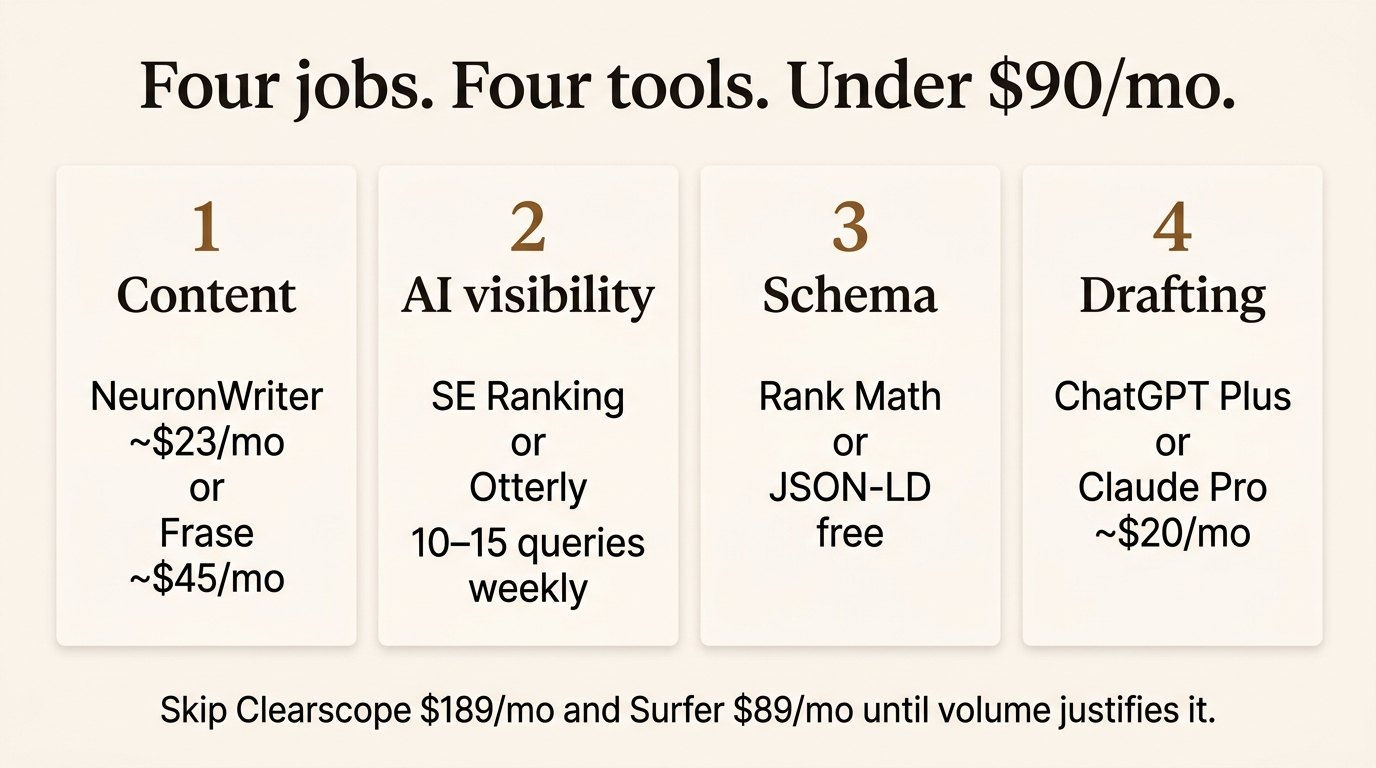
You need four tools doing four distinct jobs.
Tool 1 — Content optimization: Frase.io (~$45/month) or NeuronWriter (~$23/month). Both give you topic briefs, semantic clusters, and content scoring. For 2–4 pieces per month, either is enough. Skip Clearscope ($189/month) and Surfer ($89/month) until volume justifies the spend.
Tool 2 — AI visibility tracking: SE Ranking or Otterly. Traditional rank tracking doesn't show AI citations. SE Ranking added AI Overview tracking to its suite; Otterly is purpose-built for monitoring brand mentions across ChatGPT, Perplexity, and Gemini. Check 10–15 target queries weekly.
Tool 3 — Schema: Rank Math (WordPress) or a JSON-LD generator. Schema communicates structured facts to crawlers and AI systems: business name, author credentials, FAQs. Free on most stacks. A few minutes to set up correctly.
Tool 4 — LLM for drafting and clustering: ChatGPT Plus or Claude Pro (~$20/month). Use for briefs, keyword clustering, and checking content against reader questions. Not a replacement for your expertise and real examples.
Comparison of top content optimization tools:
| Tool | Starting price | Best for | AI visibility feature |
|---|---|---|---|
| NeuronWriter | ~$23/month | Budget optimization, scoring | No (classic SEO) |
| Frase.io | ~$45/month | Briefs + AI drafting | No |
| Surfer SEO | ~$89/month | Mid-tier teams, NLP scoring | Limited |
| Clearscope | ~$189/month | Enterprise content teams | No |
| SE Ranking | Varies | AI Overview tracking included | Yes |
| Otterly | Varies | Cross-LLM brand monitoring | Yes (core feature) |
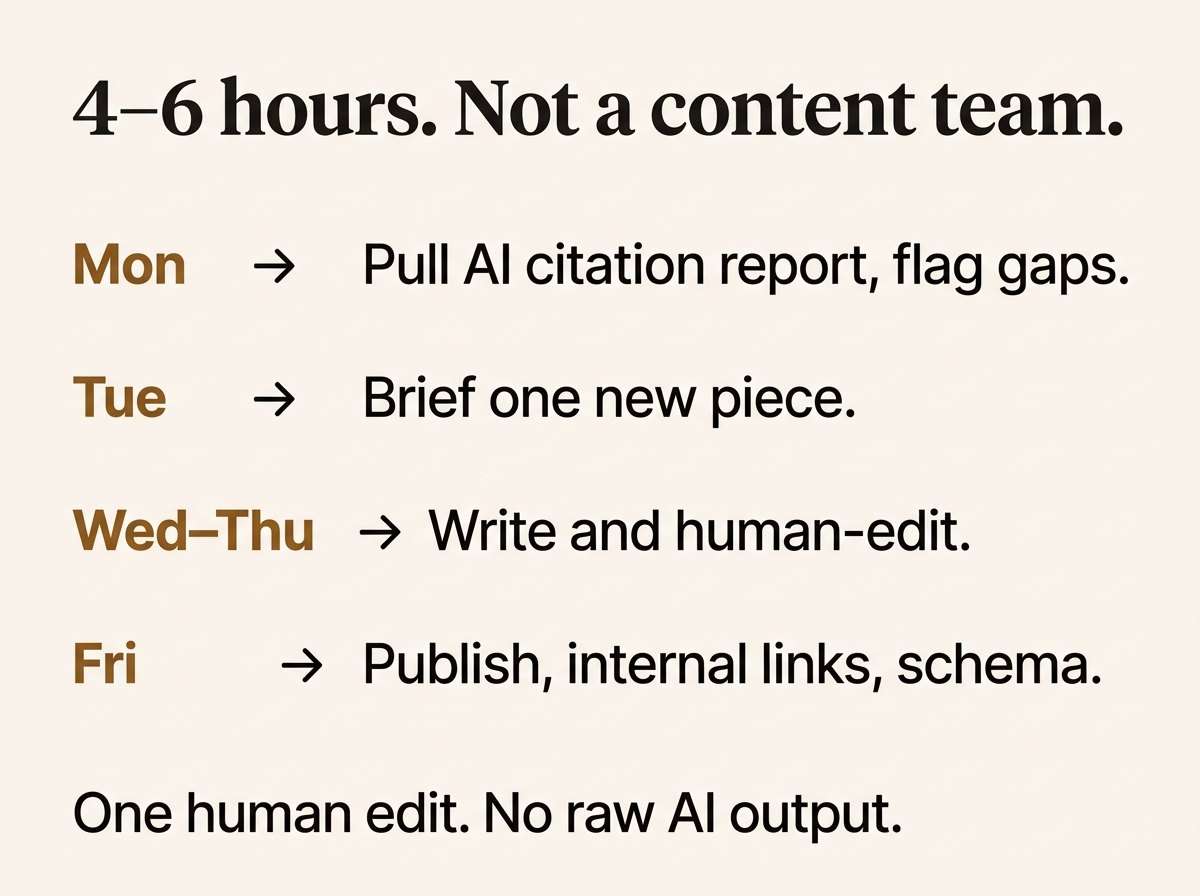
A lean weekly workflow (4–6 hours total): Monday — pull your AI citation report, flag gaps. Tuesday — brief one new piece in Frase or NeuronWriter. Wednesday–Thursday — write and edit; one human edit, no raw AI output. Friday — publish, update internal links, review schema.
Making Your Site Agent‑Ready (Semantic HTML, Forms, and Safety)
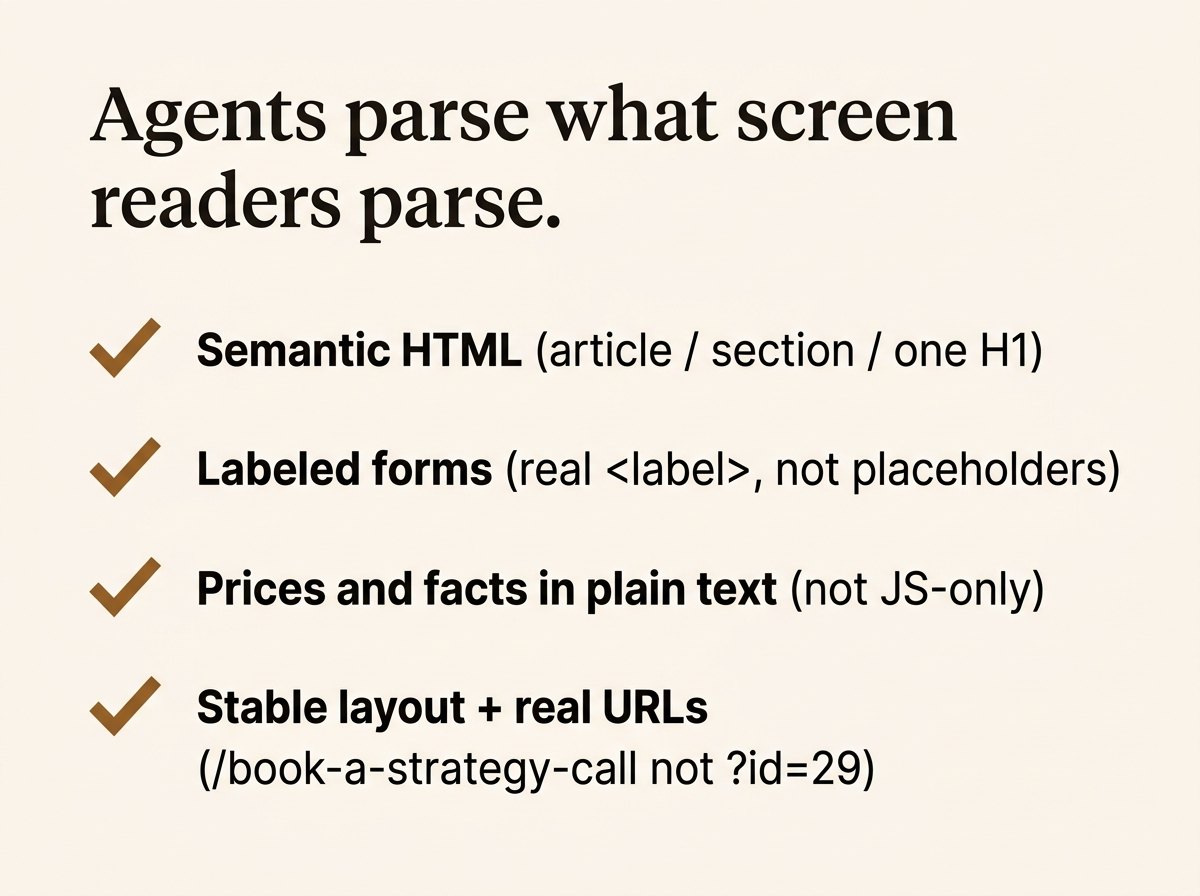
AI isn't just reading your pages anymore. Agents are beginning to act on them — booking appointments, submitting forms, filling carts. The technical changes required to be agent-ready are largely the same changes that improve AI SEO performance.
The agent‑readiness checklist:
- Semantic HTML structure. Use
<article>,<section>,<nav>,<header>,<main>, and<footer>properly. Heading hierarchy should be logical: one<h1>, then<h2>subsections, then<h3>for detail. An AI agent navigating your page does exactly what a screen reader does — it follows the structure. - Labeled forms. Every input needs a
<label>element — not just a placeholder. Agents use labels to identify fields. - Key facts as plain text. Prices, service areas, turnaround times — if they load dynamically from JavaScript, they're invisible to an agent. Plain crawlable text only.
- Stable layout and descriptive URLs. Low Cumulative Layout Shift, and
/book-a-strategy-callinstead of/page?id=29.
The practical takeaway is simple: clean structure and honest content are what both AI models and AI agents prefer. The same work serves both.
E‑E‑A‑T in Practice: Case‑Style Sections to Outrank on Trust
AI systems and Google's quality raters are looking for the same thing: evidence that the person writing this has actually done it. Most guides talk about E-E-A-T. They don't demonstrate it.
Build a visible author profile. Your author bio on every piece should name your role, your relevant experience, and link to external signals — LinkedIn, a published guest post, a course. Implement Article schema with the author property and link to your Person schema. See how that looks on this site's author page.
Create firsthand experience sections. Every major topic on your site should have at least one section that reads like field notes, not a textbook summary. What did you try? What happened? What number changed?
Even small experiments work. "I updated three pages on a client's site with question-format H2s, added FAQ schema, and monitored their Google Search Console AI Overview impressions over six weeks. Impressions from AI Overviews on those three pages increased."
Click rate from non-AI organic also improved — which we attribute to the cleaner structure attracting featured snippets. That's a real observation. It's more credible than "experts recommend structured content."
Cite the numbers that have verifiable sources. Every data point in this guide is drawn from a named study or platform. When you write AI SEO content, do the same.
Link to the Semrush AI search traffic study. Cite Google's Search Central documentation on helpful content. An AI model synthesizing answers for a query is more likely to quote a source that itself quotes credible external data.
Keep your content dated and refreshed. AI systems strongly prefer recently updated content. In a space moving as fast as AI SEO, a guide last updated in 2024 is already a liability.
Establish a quarterly review cycle: update your statistics, replace deprecated examples, and add a "what changed this quarter" section at the top. Then update the lastUpdated date in your schema and at the top of the page.
Measuring AI Visibility and Performance (Dashboard Blueprint)
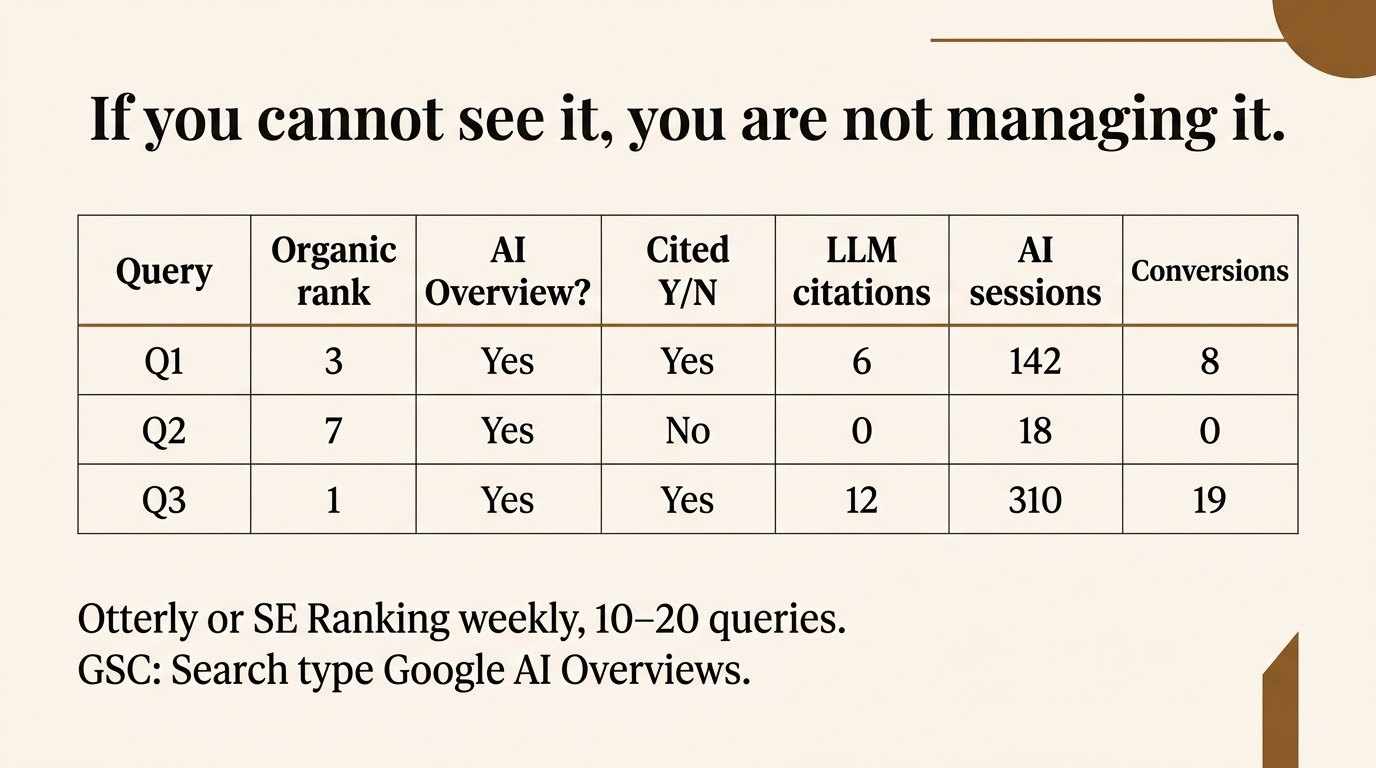
You can't manage what you can't see. Right now, most small businesses are running their AI SEO strategy blind — their analytics dashboard was built for a world where every visit came from a blue link.
Here are the metrics that matter and how to track them with a lean setup.
Citation frequency. How often does your content appear in AI Overviews or LLM answers for your target queries? Tools like Otterly and SE Ranking's AI Overview tracker let you run a list of target queries and flag which ones surface your domain or content. Run this report weekly on 10–20 queries.
AI share of voice. What percentage of AI citations in your category go to you vs. your competitors? Run the same citation check against the top three competitors in your space. If they're being cited five times more often, you have a structural content gap.
AI‑sourced sessions. In Google Search Console, filter by "Search type: Google AI Overviews" to see impressions and clicks driven specifically by AI Overviews. In your analytics platform, tag referral traffic from known AI surfaces with a UTM parameter (e.g., utm_source=perplexity or utm_source=chatgpt). These will be low volume initially. Track the trend.
AI‑sourced conversion rate. Create a separate segment in Google Analytics 4 for sessions tagged from AI surfaces. Track their goal completions — form fills, calls initiated, WhatsApp opens, purchases. Compare to your overall conversion rate. If Semrush's 4.4x figure holds in your niche, this number should stand out.
A simple spreadsheet dashboard: one row per target query. Columns: organic rank, AI Overview present, your citation (Y/N), LLM citation count, AI-sourced sessions, conversions. Update monthly. Google Search Console (free) plus one AI citation tracker (Otterly or SE Ranking) is enough to make real decisions.
Common AI SEO Pitfalls and How to Avoid Penalties
Before you sprint into a 10-article publishing plan powered entirely by ChatGPT — a quick reality check.
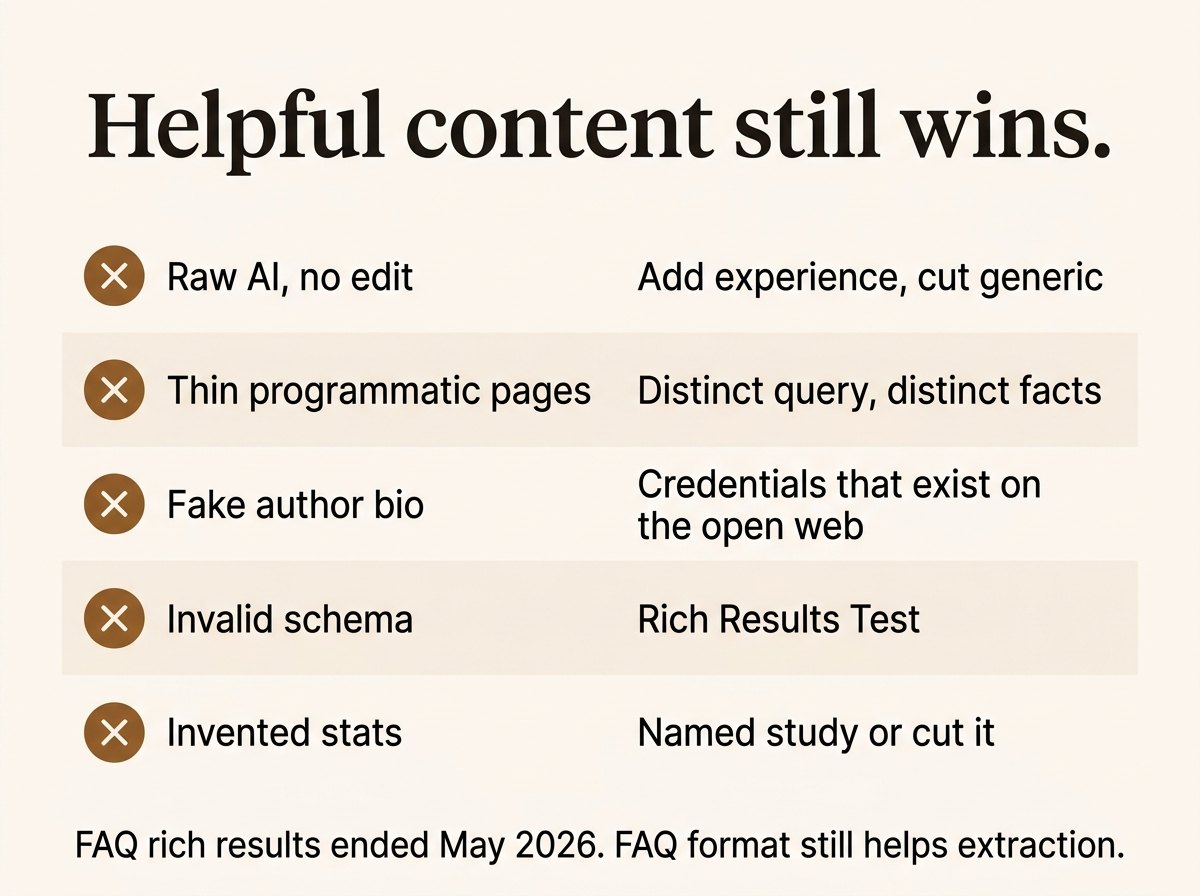
Unedited AI output will eventually hurt you. Google's helpful content system is designed to identify and demote content produced for search engines rather than for people.
Raw LLM output — no added experience, no real specifics, no human editing — hits that target. It isn't about whether AI wrote the draft. It's about whether the final piece is genuinely useful.
Edit heavily. Add real examples. Cut anything vague or generic.
Thin programmatic pages without real data are a liability. If you use AI to generate 200 location pages or 500 product variant pages with no substantive difference between them, you're building a target for a helpful content demotion.
Programmatic SEO works when each page answers a distinct query with distinct information. It fails when it's content inflation at scale.
Fake or inflated author credentials will backfire. Author E‑E‑A‑T is increasingly verifiable. If your author bio claims expertise that doesn't show up on LinkedIn, in published work, or anywhere else on the web, that's a signal problem. Keep credentials accurate and verifiable.
Validate your schema. Run it through Google's Rich Results Test. FAQ rich results were deprecated in May 2026 — no rich snippet payoff — but FAQ schema still helps AI extraction, so include it. Just validate it.
Never invent or round statistics. A number you can't source, cited by others, seeds misinformation into the training data of the AI systems you're optimizing for. If you can't trace it to a named study, cut it.
Google's helpful content policies haven't changed their intent in the AI era. Genuinely useful, well-structured, honestly attributed content wins. That hasn't changed.
FAQ: Real‑World Questions About AI SEO 2026
Is SEO still worth it in 2026, or is AI killing organic traffic?
SEO is still worth it — but the goal has shifted. You're no longer only optimizing to rank in ten blue links. You're optimizing to be cited in AI answers, surfaced in AI Mode, and found across multiple LLM platforms.
The businesses declaring SEO dead are the ones who measured it only in organic clicks. Measure it in citations, branded searches, and AI-sourced conversions, and the picture changes.
How do I get my content into Google's AI Overviews?
There's no submission process. AI Overviews are generated dynamically from indexed content. To increase your chances: write direct structured answers to exact questions your audience asks, use question-format headings, keep answer blocks under 200 words, build topical authority through a content cluster, and keep your site technically clean.
What is GEO, and do I need a separate GEO strategy?
Generative Engine Optimization (GEO) is optimizing your content specifically to be cited in AI-generated answers — not just ranked in SERPs. You don't need a completely separate strategy.
The same principles that make content rank well (clear structure, genuine expertise, credible sourcing, topic depth) also make it more likely to be cited. The difference is in how you write: answer-first format, specific data, named sources, and short extractable blocks matter more in GEO than keyword density ever did.
Can small businesses afford AI SEO tools?
Yes. A functional AI SEO stack can run under $90/month: NeuronWriter (~$23/month) for content optimization, SE Ranking's AI tracker for citation monitoring, Rank Math for schema on WordPress (free tier available), and ChatGPT Plus (~$20/month) for briefs and clustering.
You don't need Clearscope, Semrush, and Ahrefs simultaneously. Pick one tool per function, use it consistently, and upgrade when the volume justifies it.
How often should I update my AI‑focused content?
Every quarter at minimum. AI systems strongly favor recently updated content — guides dating to 2023 or 2024 are already losing ground on fast-moving topics like AI SEO.
Set a calendar reminder to review your core pillar pages every 90 days: update statistics, replace deprecated examples, and adjust any strategy sections overtaken by new platform behavior.
Conclusion: Shipping Your First AI Answer Funnel in 90 Days
The fundamentals haven't been destroyed — they've been extended.
Your content still needs to be genuinely useful, technically sound, and backed by real expertise. What's new is where the traffic arrives from. AI Overviews, LLM answers, and AI Mode are a new distribution channel that sends visitors who convert at 4.4 times the rate of traditional organic search.
The constraint: you have to be cited, not just ranked — and you have to have a path ready for when the visitor arrives.
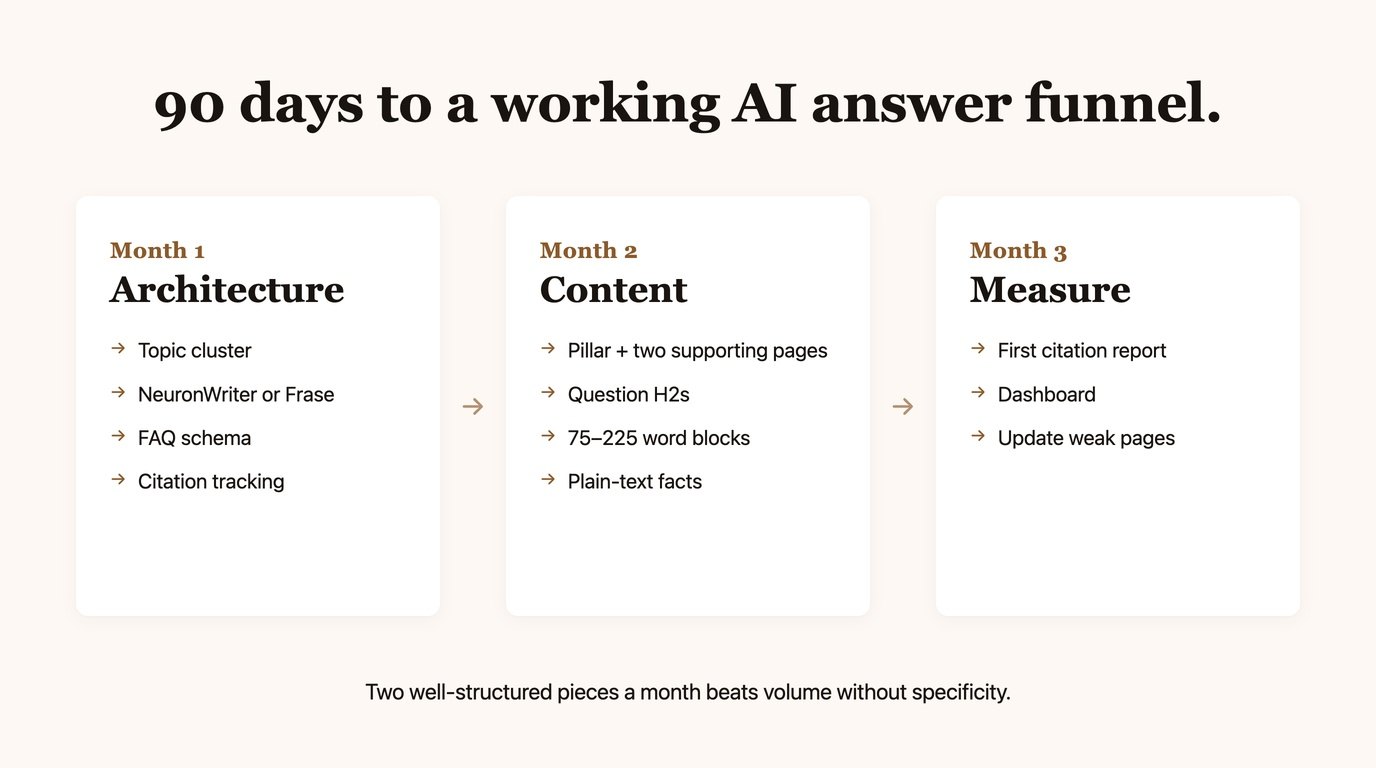
A 90-day roadmap to your first AI answer funnel:
Month 1 — Architecture and stack. Map your topic cluster. Set up NeuronWriter or Frase. Add FAQ schema to key pages. Set up AI citation tracking.
Month 2 — Content and agent readiness. Publish your pillar and first two supporting pages with extractable formatting: question headings, answer-first structure, 75–225 word blocks. Audit your HTML structure and make sure key facts are plain text.
Month 3 — Measurement and iteration. Pull your first AI citation report. Set up the tracking dashboard.
Identify gaps. Update weak pages. Repeat.
Consistent beats sophisticated. A small operator who publishes two well-structured pieces per month, tracks AI citations weekly, and updates their best pages every quarter will outperform a big agency campaign that produces volume without specificity.
Three ways to go deeper, depending on where you are right now:
No. 1 — Brand Positioning Intensive. You're not sure which seed topic to own, or your current site has no clear angle. We find your positioning, map your topic cluster, and build the strategic foundation — before you write a single word. Book a discovery call.
No. 2 — SEO Foundation Setup. You know what you do. Your structure just isn't AI-ready yet — no cluster, missing schema, scattered content. Done-for-you: architecture, tool stack, and first content cluster live. See services.
No. 3 — All-Way-In Brand Package. Positioning, digital foundation, content architecture, monthly iteration, and coaching on every decision — end to end, built around your business, not a template.
Reach out if any of those fits where you are. The link is in the nav.